
13-Year-Old Swims 2.5 Miles Through Rough Seas to Save Mother and Siblings
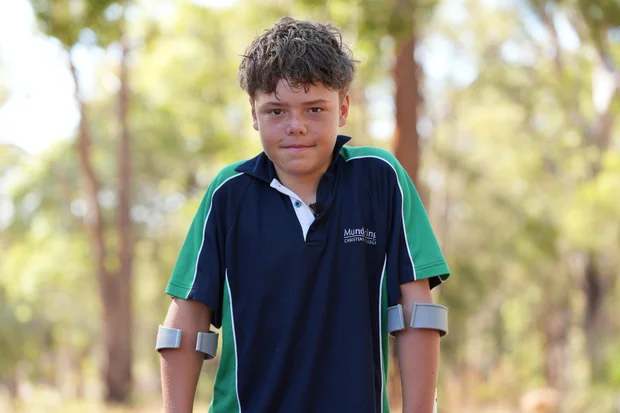
A dramatic rescue off the coast of Western Australia has drawn global attention after a 13-year-old swam more than 2.5 miles through rough seas to raise the alarm and save his family, while authorities stress that such circumstances should never place children on the frontline of life-threatening emergencies.
A family holiday turned into a survival ordeal when a mother and her three children were swept out to sea by worsening ocean conditions off the Western Australian coast. What followed was an extraordinary chain of events in which a 13-year-old child’s endurance and determination played a decisive role in preventing loss of life.
Austin Appelbee, 13, had been kayaking with his mother, Joanne Appelbee, 47, and his younger siblings, Beau, 12, and Grace, 8, when strong winds and heavy waves pushed them farther from shore. As the situation deteriorated, it was determined that help needed to be reached urgently.
The decision was made for Austin to attempt to swim to shore and raise the alarm, while his mother remained with the two younger children. The choice, later described by Joanne as one of the hardest she had ever made, was taken under extreme pressure and in the absence of immediate alternatives.
Austin initially attempted the journey using an inflatable kayak, which began to take on water. He then entered the sea wearing a life jacket, swimming for nearly two hours before realising it was slowing his progress. The jacket was removed, and the swim continued for another two hours through rough and exhausting conditions.
To remain focused, Austin later said his attention was fixed on positive thoughts, repeating familiar songs in his mind to block out fear and fatigue. After approximately four hours in the water, he reached shore, collapsed from exhaustion, and alerted authorities.
A large-scale rescue operation was launched. Several hours later, a search helicopter located Joanne and the two younger children clinging to a paddleboard nearly 14 kilometres from where they had entered the water. They had spent close to 10 hours at sea, exposed to cold and rough waves.
All family members were medically assessed and treated for exposure. None required hospital admission.
Police and marine rescue officials praised the courage and endurance shown during the ordeal. One rescue commander described the swim as “superhuman,” while police stated that the determination shown ultimately saved lives.
Despite the praise, authorities and child-safeguarding advocates have emphasised that the incident must not be interpreted as an example to place children in harm’s way. Emergencies involving oceans, natural forces, or extreme risk should never rely on children as primary responders.
Experts stress that while Austin’s actions were remarkable, they were taken under duress, not by design. Children should not be placed in situations where life-or-death decisions fall on them, particularly in environments as unpredictable as open water.
“This outcome was extraordinary, but it does not make the circumstances acceptable,” a marine safety official noted. “Children should be protected from such risks, not expected to overcome them.”
Lessons in preparation, not expectation
The incident has reignited conversations around child safety, supervision, and emergency preparedness. Specialists say the focus should remain on prevention: proper weather assessment, safety planning, close adult supervision, and immediate access to emergency services.
At the same time, Austin’s experience has been highlighted as an example of how children can be supported to develop calm decision-making skills, resilience, and awareness without being burdened with adult responsibilities.
Such capacities, experts say, are shaped gradually through parenting that emphasises safety education, emotional regulation, and trust, not through exposure to danger.
Joanne Appelbee later described how she worked to keep her younger children calm while waiting for rescue, singing and speaking positively even as conditions worsened. That steadiness, combined with swift rescue efforts, was credited with helping the family survive.
A story of survival, not a standard
Austin has repeatedly said he did not see himself as a hero, describing his actions as doing what felt necessary in the moment. While his courage has inspired many, safety advocates underline that no child should ever be expected to repeat such an act.
The story, they say, is not a blueprint for bravery, but a reminder of the importance of safeguarding children so they are never forced into such situations.
In the end, the outcome was one of survival and reunion. But the lasting message, authorities stress, is clear: children must be protected first, even when their courage shines brightest.