
Ending Impunity for Crimes Against Journalists: Protecting Voices That Protect Democracy
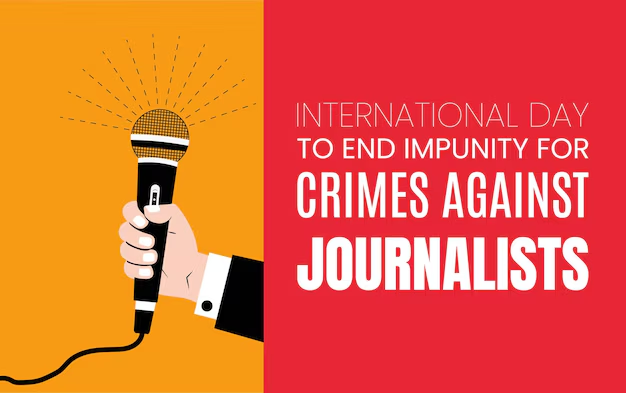
Every year on November 2, the world observes the International Day to End Impunity for Crimes Against Journalists (IDEI).
The day highlights the continued threats, violence, and murders journalists face while performing their duties. Despite increased awareness, impunity remains widespread: perpetrators often escape consequences, enabling violence to thrive in silence.
Impunity not only takes lives. It fuels self-censorship, weakens public trust in justice, and emboldens those who seek to conceal wrongdoing.
Why the International Day to End Impunity for Crimes Against Journalists Matters
Journalists and media professionals play an essential role in safeguarding freedom of expression and the free flow of information. When journalists are silenced, whether by threats, censorship, violence, or death, the public loses its capacity to hold people in power to account. Democracy suffers.
The UN General Assembly acknowledged this reality in Resolution A/RES/68/163, adopted in December 2013. The resolution firmly condemns violence against journalists and calls on states to create safe environments that enable media workers to operate without interference, fear, or reprisal.
Rising Attacks on Journalists
Threats against journalists have become more frequent and diverse. Beyond physical attacks, beatings, harassment, detention, abduction, and murder, journalists increasingly face digital intimidation.
The surge in online harassment has made social platforms new battlegrounds. Women journalists are disproportionately targeted. According to research by the International Center for Journalists,
- 73% of female journalists surveyed reported online violence.
- 25% received threats of physical harm.
- 18% faced threats of sexual violence.
Such gender-based digital abuse silences voices, undermines public discourse, and weakens democratic participation.
Technology-Facilitated Gender-Based Violence
“The digital world should expand creativity and empowerment, but instead it has become a site of harassment, intimidation, and cruelty for many women.”
New forms of abuse include:
- Hacking and doxxing
- Cyberbullying
- Astroturfing
- Non-consensual image/video distribution
- Defamation and impersonation
- Stalking and sexual harassment
The rise of generative AI has enabled more advanced threats known as technology-facilitated gender-based violence (TFGBV), such as deepfakes, manipulated images, etc.
As digital platforms shape public debate, silencing women journalists is not merely an attack on individuals; it is an attack on democracy itself.
On the Front Lines
Journalists covering protests or conflict zones are often assaulted despite wearing visible “PRESS” insignia. Some are beaten, pepper-sprayed, or shot with rubber bullets. Unknown actors also vandalize media houses. Women reporters endure rape threats, hate campaigns, and exposure of their personal information.
Some journalists investigating organized crime and corruption disappear or are found dead under questionable circumstances. Many of these cases remain unresolved.
2025 Theme for the International Day to End Impunity for Crimes Against Journalists
The theme “Chat GBV: Raising Awareness on AI-Facilitated Gender-Based Violence Against Women” highlights the urgent and evolving challenge of AI-driven abuse, particularly against women journalists. It seeks to:
- Expose and combat AI-enabled gender-based violence
- Support safer environments for women media professionals
- Strengthen implementation of the UN Plan of Action on the Safety of Journalists and the Issue of Impunity
The theme calls for education, advocacy, and policy action to ensure the digital realm remains a tool for empowerment, not oppression.
History of the International Day to End Impunity for Crimes Against Journalists
The day’s roots trace back to 2011, when the International Freedom of Expression Exchange (IFEX) declared November 23 as the International Day to End Impunity. The date commemorated the 2009 Ampatuan (Maguindanao) massacre in the Philippines, where 57 people, including 32 journalists, were murdered, marking one of the deadliest attacks on press freedom.
In 2013, following strong global advocacy, the UN General Assembly adopted Resolution 68/163, designating November 2 as the International Day to End Impunity for Crimes Against Journalists. The date honors two French journalists, Ghislaine Dupont and Claude Verlon, killed in Mali earlier that year.
Since then, the International Day to End Impunity for Crimes Against Journalists has become a global platform to raise awareness, remember victims, advocate for justice, and strengthen protections for media professionals worldwide.
Staggering Numbers
According to the UNESCO Observatory of Killed Journalists,
- Nearly 1,800 journalists were killed between 2006 and 2025
- Around 90% of these cases remain unsolved
Such persistent impunity fuels a cycle of violence, threatening both journalists and the public’s right to information.
Why Ending Impunity Matters
Impunity encourages repeat offenses. Justice denied emboldens criminals, silences truth, and shields corruption. Protecting journalists is not about giving in to the press; it is about defending democracy, truth, and public rights.
The International Day to End Impunity for Crimes Against Journalists urges governments, media organizations, civil society, and individuals to join global efforts that:
- Strengthen justice systems
- Demand accountability
- Promote media safety
- Support free expression
Conclusion
Despite the danger, journalists continue to report with remarkable courage. They deserve systems that value and protect their service. Justice for crimes committed against journalists is fundamental to safeguarding truth and democracy.
Defeating impunity is everyone’s responsibility. When a journalist is silenced without consequence, society loses more than a storyteller; we lose the ability to question the power that be.
To protect truth, we must protect those who pursue it.