A Serious Conversation About Bullying, Environments, and the Children We Are Producing

There is a conversation we keep having about bullying which keeps arriving too late. It arrives after a child has been hospitalised. After a video has gone viral. After a family is standing at a graveside asking questions that no one in authority can adequately answer. We convene panels. We issue statements. We call for investigations. And then, slowly, the news cycle moves on and so do we. Until cycle gets repeated again.
This pattern is not a failure of concern. Most people genuinely care about children. It is a failure of understanding. We have continued to treat bullying as an isolated behavioural incident rather than what it actually is: a safeguarding and protection crisis with roots that run deep into the environments we have built, the cultures we have allowed, and the examples we have modelled.
If we are serious about stopping it, we must be willing to go further than we have gone before.
Bullying Does Not Emerge in a Vacuum
The first thing we must accept is this: bullying is produced. It is also tolerated, reinforced, and mishandled and each of those failures happens inside an environment. Any serious response to bullying must therefore confront three dimensions simultaneously.
The first is the child who bullies. The second is the environment that enables the bullying. The third is the environment that responds or fails to respond when bullying occurs.
Until we address all three dimensions together, we will keep treating symptoms and calling it progress.
Research on youth violence is increasingly clear on one point: the fastest-growing group of perpetrators of violence against children are other children and young people: the classmates, the peers, the children in the next seat. But here is what the same research tells us: these children are not the originators of violence. They are replicators of it.
Our children are either beneficiaries or casualties of our examples. A child who grows up witnessing aggression at home, consuming cruelty online, or watching mockery modelled by adults in positions of authority does not arrive at school as a blank slate. That child arrives having already learned something; that domination is power, that cruelty is normal, that the strong take from the weak and call it strength.
We cannot be surprised by what our children produce when we have never audited what we have fed them.
What Schools Must Confront
For too long, schools have understood their mandate narrowly; as places that produce literacy, numeracy, and certificates. Academic outcomes are measured. Behavioural and emotional outcomes are largely left to chance.
The result is a generation of children who may be able to pass examinations but who remain disturbingly underdeveloped in empathy, self-regulation, respect, and conscience. We cannot continue to celebrate grades while ignoring broken behaviour.
A school exists first to protect before it can truly teach. Safeguarding is not an add-on to education. It is not a box to tick in a compliance document. It is the foundation that makes education legitimate. If a child does not feel safe, learning is already compromised. The child sitting in fear cannot absorb a lesson. The child being humiliated in the corridor cannot concentrate in the classroom.
Safeguarding is not a side conversation. It is the first conversation.
Once that foundation is secure, the school can pursue its second purpose: learning and the formation of character. But schools that have neglected this foundation, that have prioritised results over culture should not be surprised when cruelty thrives in the gaps they have left open.
What We Tolerate, We Teach
Culture is not built by slogans painted on walls. It is not produced by a single assembly or an annual awareness week. Culture is built intentionally, maintained consistently, and transmitted through what adults in authority choose to do and choose not to do every single day.
What we tolerate, we teach. What we model, children absorb. What we excuse, they normalise.
A comprehensive child safeguarding and protection system in every school is not optional. It must exist not as a document filed in a drawer, but as a living culture, breathing through every classroom, every corridor, every staff interaction, and every reported incident.
That means policy is codified and understood. Processes are clear. Training is ongoing for staff and for children alike. Reporting pathways are unambiguous. Intervention is consistent. Consequences are known in advance. Support systems for both victims and those who bully are real and accessible.
It also means moving beyond purely punitive thinking. Punishment has its place. But punishment alone has never produced transformation. Societies that have made meaningful progress on youth violence have done so by doing more than excluding and suspending, they have intentionally built positive value systems, strengthened support structures, and created environments that redirect behaviour rather than merely condemning it.
Kindness must be taught. Boundaries must be taught. Accountability must be taught.
What Parents Must Do
Schools cannot carry this alone. The home is Ring One.
Parents and primary caregivers must first audit what their children are absorbing in the environment they control. Not what is on the school notice board; what is happening at the dinner table, what is being watched on screens, what language is being used between adults, what conflicts are being modelled and what resolutions are being demonstrated.
Beyond that, parents must be observant. Bullying rarely announces itself loudly. It hides in silence, in changing behaviour, in manufactured excuses, in small signs that adults miss because they are not looking.
Signs that a child may be experiencing bullying include:
A reluctance to attend school or school activities. Clothing, belongings, or work that is torn, missing, or damaged without explanation. Unusual or illogical routes taken to and from school. A child who returns home sad, anxious, withdrawn, or moody. Loss of appetite, low self-esteem, frequent physical complaints; headaches, stomach-aches, fatigue with no medical cause. Disturbed sleep, bad dreams, or significant changes in sleep patterns.
Signs that a child may be engaging in bullying behaviour include:
A positive attitude toward aggression or domination. Impulsive, easily angered, or frequently defiant behaviour. A marked lack of empathy toward others. Aggressive responses to correction from teachers, parents, or other adults in authority.
When children show these signs, they need two things above everything else: to be seen, and to be heard. One of the most devastating aspects of bullying situations is how often children do speak up and how often nothing happens. The failure to respond to a child who has spoken is not a neutral act. It is a message. It tells that child that what is happening to them does not matter enough to act on. That silence costs more than we can calculate.
What Children Can Do
Equipping children with practical responses is part of the work.
For children experiencing bullying: where it is safe to do so, ignoring and walking away removes the attention the bully is seeking. Building friendships creates protective networks. And knowing — truly knowing — that there are trusted adults who will take them seriously when they speak is one of the most powerful protective factors a child can have.
For children who witness bullying: the bystander is not neutral. A bystander either becomes part of the problem or part of the solution. A child who tells the bully to stop, who refuses to laugh, who gets adult help, or who simply stays beside the victim rather than walking away, that child is exercising moral courage. That is not a small thing. That is character in action.
For parents whose child is the one bullying: this is hard. Harder, often, than being the parent of a victim. But it is not the end of the story. Taking it seriously, setting firm and consistent limits, helping the child understand the impact of their behaviour, and seeking professional support where needed, these are the responses that actually interrupt the cycle rather than simply displacing it.
This Is Not Someone Else’s Problem
To truly stop bullying, we must stop waiting for the incident that is impossible to ignore. By then, someone has already paid a price we cannot give back.
The fight against bullying and violence against children requires a comprehensive approach, one that addresses root causes, builds safe environments, and invests in the environments that shape children long before any particular crisis arrives.
Schools must build cultures, not just policies. Homes must model what they expect to see. Communities must stop excusing and normalising what they should be confronting. And every adult who works with children — in any capacity — must understand that they are not a spectator.
Every child deserves to feel safe. Not occasionally. Not in certain buildings, on certain days, with certain adults nearby. Safe as a foundation. Safe as a non-negotiable.
That is what we are building.
And the next step in building it is coming in April.
You Are Invited
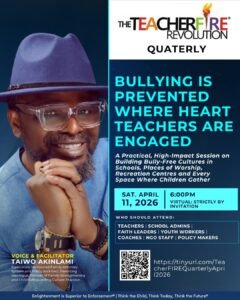
TeacherFIRE® Revolution Quarterly — April 2026
A Practical, High-Impact Session on Building Bully-Free Cultures in Schools, Places of Worship, Recreation Centres, and Every Space Where Children Gather
The conversation this article has started, this session will take further.
TeacherFIRE® Revolution Quarterly brings together parents, educators, school leaders, faith leaders, child welfare professionals, and community builders for a session that does not stop at awareness. Participants leave with understanding, frameworks, and tools they can use immediately in every environment where children are in their care.
Date: Friday, 10 April 2026 Time: 6:00 PM Format: Virtual Access: By Invitation Only — Register and await your invitation
Joining link: Sent upon confirmed invitation
Facilitated by: Taiwo Akinlami Egalitarian. Renowned Family Attorney. Parenting Ideologue. Pioneer of Family Strengthening and Child Safeguarding Culture Practice.
Register now and await your invitation.
See you Soon.