
Fela, Atiku, Davido: Priceless Lessons on Fatherhood, Legacy, Restraint, and Change
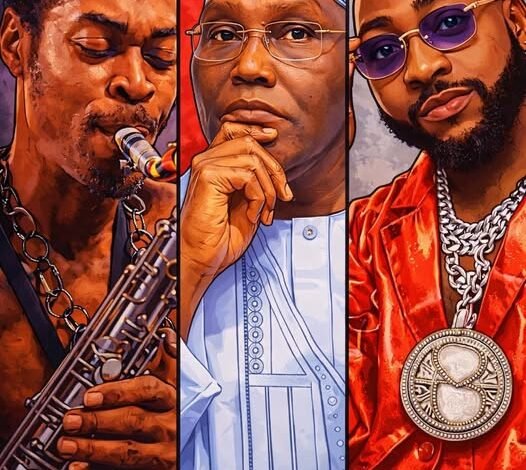
Last week felt like an unofficial “Fathers’ Week” in Nigeria, not by decree, but by the sheer volume of public conversations that touched fatherhood, legacy, family name, and what children do with the worlds they inherit. As a #50plusdad raising a son in my own twilight seasons, I watched three stories and extracted one composite lesson: fatherhood is not only biological; it is cultural, reputational, and generational.
The first story was political. A son of a major national political figure, former Vice President Atiku Abubakar, publicly aligned himself with the ruling party, a choice many interpreted as standing with the incumbent camp against his father’s political interests. The public reaction was predictable: questions about loyalty, ambition, independence, and whether a son’s political distance is a commentary on a father’s viability. In our culture, symbolism is read into everything, especially when it plays out inside a family.
Yet what held my attention was not the son’s decision; it was the father’s response. Atiku described his son’s move as a personal choice and refused to turn it into a family war. That restraint is fatherhood in public: absorbing what could embarrass and still choosing dignity. It is one thing to be disagreed with; it is another to be disagreed with publicly by one’s own. In moments like that, the temptation is to retaliate, disown, or weaponize affection. But fatherhood, at its mature end, is often the discipline of refusing to destroy what we did not create. We did not create human will; we only steward influence. Scripture says, “Train up a child in the way he should go…” (Proverbs 22:6). Training is not coercion; it is formation. And formation still leaves room for agency.
The second story was personal, but it became public by force. Davido’s father, Dr. Adedeji Adeleke, spoke about a paternity allegation that had trailed the family, stating that DNA tests showed Davido was not the child’s father. I watched that moment less as a father “defending a son” and more as a patriarch defending a family name, because reputations do not separate neatly in public discourse. When a child is called out, the household is dragged into the courtroom of opinion, and fathers, by the nature of position, often become the first line of institutional response.
What struck me most was how avoidable many public storms are, especially when there has been some level of contact to begin with. In Dr. Adeleke’s statement, he did not argue that there was no prior relationship; rather, he focused on the fact that the paternity claim was tested and disproved. That detail matters, because it quietly points to a lesson without turning the moment into a moral trial.
Public figures attract opportunists, yes, and allegations can arise even where there was no intimacy. But when there has been a liaison, however brief, the door opens wider to needless controversy. A moment of indiscretion can become a prolonged reputational tax: attention, energy, emotional bandwidth, public trust, and the dignity of everyone involved. Scripture’s warning is therefore practical, not preachy: “A good name is rather to be chosen than great riches” (Proverbs 22:1). A name is not only a label; it is a legacy container.
Nobody is perfect, and this is not written from a place of judgment. It is written as a reminder, especially to young people that self-governance is protective. Restraint is not punishment; it is preservation. When we live casually, we make our future more expensive than it needs to be. When we live wisely, we reduce the needless battles our parents, spouses, and children may one day have to fight in our name.
The third story was cultural: the online flare-up that followed a comment credited to Wizkid, an audacious comparison that placed his relevance above Fela Anikulapo Kuti’s. What interested me was not the claim itself (people will always talk), but the family’s mixed responses and the lesson hidden inside them.
Two members of Fela’s family chose restraint. They disagreed without becoming disagreeable. They corrected the tone without turning the moment into an exchange of insults. That is not weakness; it is emotional government, the quiet strength of knowing that not every provocation deserves a reply, and not every reply deserves a stage.
Another member of the family, Seun Kuti, took a more combative route and entered the arena. I acknowledge his right to do so. Everyone has a right to defend their father’s name, and in our clime, silence is sometimes interpreted as consent. Yet even when that right exists, wisdom still asks a harder question: is this the best use of voice and energy? There is a difference between defending legacy and feeding noise; between correction and escalation. Not every barking dog deserves a stone; if we stop to throw at every dog, we may never reach our destination, says Churchill.
Because greatness is not established by debate. Greatness is established by facts, impact, innovation, endurance, and the capacity to shape a generation. Time eventually sifts both hype and heritage. Nobody holds the crown forever, whether in music, sport, politics, or any other human empire. The same history that crowned champions has also replaced them. Muhammad Ali was a giant, and yet boxing moved on. Pelé was a legend, and football produced other legends. Their replacements did not diminish their greatness; they proved the continuity of the human story.
That is why I resist the fear that someone else’s rising automatically means someone else’s fall. A pioneer lays a foundation; others build on it. That building does not cancel the pioneer; it confirms him. Scripture puts the principle on record: “One generation shall praise thy works to another, and shall declare thy mighty acts.” (Psalm 145:4). Continuity is not competition; it is calling.
And for fathers, biological fathers and “industry fathers”, this is not only a cultural lesson; it is a fatherhood lesson. The prayer is not that our children should remain beneath us forever; the prayer is that they should go farther, with better tools and deeper reach. The glory of the former can be real, and yet the latter can be greater, without disrespect, without insecurity, without panic.
So the better posture is this: let greatness speak for itself. Let legacy be defended by substance, not by shouting. And when provoked, let response be governed by wisdom, not by the need to win a moment, but by the commitment to preserve dignity.
These three stories, political independence, family name under scrutiny, and cultural legacy under debate, converge into one sobering reflection for anyone raising children today, we do not only raise children; we raise interpreters. Children interpret what we do, what we tolerate, what we celebrate, and what we hide. And those interpretations become their adult choices.
This is why fatherhood cannot be reduced to provision alone. Provision without values is simply funding a future we may not like. Provision without relationship is building a house where affection does not live. Scripture places the weight where it belongs: “Except the Lord build the house, they labour in vain that build it… Lo, children are an heritage of the Lord.” (Psalm 127:1–3). Heritage is not merely inheritance; it is identity handed over.
In our own homes, what we most need, especially as we grow older is the humility to accept that fatherhood is never finished; it only changes form. When sons choose differently, we can respond with bitterness or with maturity. When public storms rise, we can defend truth without becoming rabble-rousers. When culture debates legacy, we can disagree without becoming disagreeable. In all of it, we can remember that children may not repeat our instructions, but they often repeat our patterns.
So my #50plusdad reflection is simple: fatherhood is stewardship. The goal is not control; the goal is formation. The goal is not to “win” every family conflict; the goal is to preserve relationship, character, and name. And the hope is that what we deposit, values, restraint, faith, and love, will outlive the noise of any season.
If we hold that line, then even when children make choices we would not make, we still have room to bless, to guide, to correct, and to keep the door open because the end of fatherhood is not dominance; it is legacy with dignity.
Do have an INSPIRED week ahead with the family.

