Human Rights Lawyer Inibehe Effiong Raises Alarm Over Deplorable Classrooms in Uyo, Sparking Concerns Over Children’s Right to Development
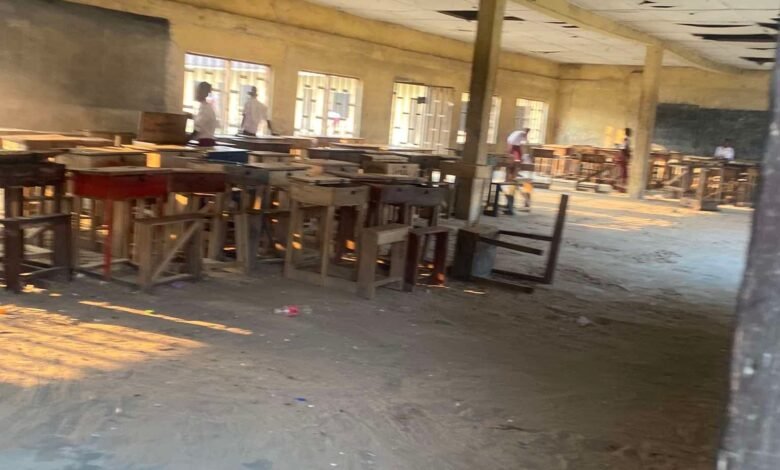
Photos and reports from Community Comprehensive Secondary School, Four Towns, Uyo, recently shared by lawyer and public affairs commentator Inibehe Effiong, reveal a disturbing picture of the state of public education in Akwa Ibom State.
The images of dilapidated classrooms, broken structures, and unsafe learning spaces are not just isolated evidence of neglect. They reflect a deeper failure that touches on the rights and future of the children who attend the school.
Situated close to the Akwa Ibom State Secretariat, right in the heart of the state capital, the school stands as a painful contradiction. In a state that has reportedly received more than ₦2.53 trillion in federal allocations over the last 32 months, one would expect public schools to provide safe and dignified spaces for learning. Instead, what exists in Four Towns is an environment that raises serious concerns about the protection of children’s right to development.
Under Nigeria’s Child Rights Act (2003) and international child protection standards, every child is entitled to conditions that support their physical, intellectual, and emotional development. Education is a central part of that right. However, when students are forced to learn in buildings that are visibly deteriorating and unsafe, the state is failing in its duty to provide the basic conditions necessary for that development.
The Child Rights Act, 2003, clearly establishes this obligation. Section 1 of the Act provides:
“In every action concerning a child, whether undertaken by an individual, public or private body, institutions or service, court of law, or administrative or legislative authority, the best interest of the child shall be the primary consideration.”
The law further guarantees the right of children to grow and develop in Section 4, which states:
“Every child has a right to survival and development.”
This protection is reinforced by international law under the United Nations Convention on the Rights of the Child (1989), which Nigeria ratified in 1991. Article 29(1) of the Convention states:
“States Parties agree that the education of the child shall be directed to the development of the child’s personality, talents and mental and physical abilities to their fullest potential.”
The condition of this school can therefore be seen as a miniature reflection of a larger societal problem. Public institutions that should serve the people are often left to decay, while public resources are directed toward political comfort and prestige. When governance priorities shift away from essential services like education, the most vulnerable members of society, children, are the ones who pay the price.
Schools are not just places where children receive lessons. They are spaces where confidence is built, curiosity is encouraged, and the foundation for future participation in society is formed. When those spaces are neglected, it signals to students that their aspirations matter less.
The story highlighted by Inibehe Effiong is therefore not just about one school in Uyo. It raises a broader question about accountability and priorities.
If the environment in which children are meant to learn mirrors neglect, it reflects a society that must urgently reconsider how it values its future. Ultimately, every action and decision that affects children must be guided by one clear principle: the best interest of the child must prevail at all times.