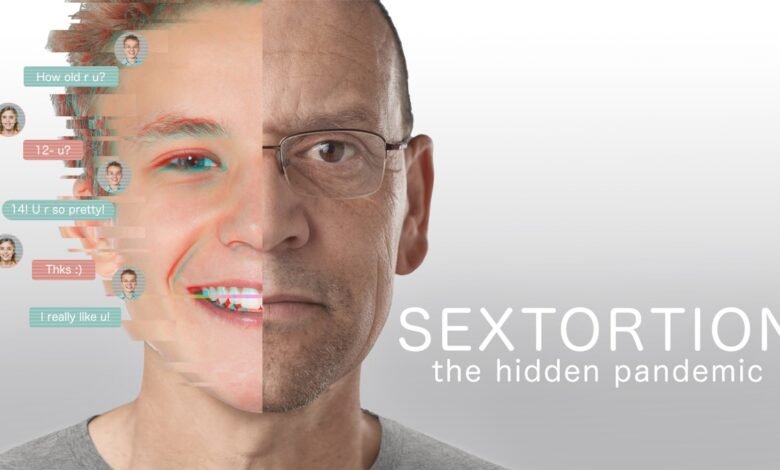
MOVIE REVIEW OF THE WEEK: SEXTORTION – THE HIDDEN PANDEMIC (2022)
A Chilling Window Into the Digital Crime Every Parent Must Know
Directed by: Maria Demeshina Peek
Year: 2022
Where to Watch: Amazon Prime Video
Imagine your child is alone in their bedroom. The door is closed. The house is quiet. And somewhere across the world, a predator is talking to them, telling them they are beautiful, they are special, they are understood. Within weeks, that same predator will have a weapon: an image, a screenshot, a moment of vulnerability and they will use it to destroy your child’s world.
This is not a nightmare scenario. This is sextortion and it is happening to one in seven children online right now.
Sextortion: The Hidden Pandemic, the 2022 documentary directed by Maria Demeshina Peek and produced by Auroris Media in partnership with the National Center for Missing & Exploited Children (NCMEC), is one of the most important films you will watch this year. Not because it is entertaining, though it is gripping but because it carries information that could save a child’s life.
“Sexual predators have found a way to extort children in the privacy of their homes. They don’t need a key to get in, just a device connected to the internet.” — John Shehan, Vice President, NCMEC’s Exploited Children Division
WHAT IS SEXTORTION? UNDERSTANDING THE CRIME
Sextortion is a form of digital blackmail in which a predator, often posing as a peer, romantic interest, or online friend manipulates a child into sending sexually explicit images or videos. Once obtained, those materials become a weapon. The predator threatens to send them to the victim’s parents, schoolmates, or the wider public unless the child complies with ever-escalating demands: more images, money, or in-person meetings.
What makes sextortion especially insidious is that it is reportedly 1,000 times more prevalent than child sex trafficking, yet most parents have never heard of it.
Reports of online enticement, which includes sextortion, have skyrocketed in recent years. At NCMEC’s CyberTipline, online enticement reports increased 98% from 2019 to 2020 alone rising from 12,070 in 2018 to 44,155 by 2021. Since the CyberTipline launched in 1998, it has received more than 116 million reports of suspected child sexual exploitation. These are not abstract statistics. Behind every report is a child.
AMANDA TODD: A STORY THAT CHANGED THE WORLD
The documentary is anchored by one of the most haunting and heartbreaking stories of the digital age. Amanda Todd was 13 years old when she met a stranger in an online chat room. He told her she was “stunning, beautiful, perfect.” He convinced her to briefly flash her webcam. That single moment, lasting seconds would haunt her for the rest of her short life.
The predator captured the image and later threatened to distribute it unless she “put on a show” for him. When she refused, he followed through sharing the topless image with her friends, classmates, and even their parents. Amanda moved schools. He found her again. She moved again. He found her again. The cyberbullying became relentless.
In September 2012, Amanda Todd posted a nine-minute YouTube video holding up handwritten flashcards telling her story without saying a word. It is one of the most moving pieces of testimony ever recorded. A month later, on October 10, 2012, Amanda ended her life. She was 15 years old.
Her mother, Carol Todd, speaks in the documentary with a quiet dignity that is all the more devastating for its composure. After losing her daughter, Carol founded the Amanda Todd Legacy Society to spread awareness about sextortion and cyberbullying. “There weren’t many stories out there,” she says. “I became interested in sharing Amanda’s story so kids wouldn’t fall into the same trap. It became my life’s work.”
THE INVESTIGATION: A ‘TOP GUN’ PILOT AND A GLOBAL WEB OF VICTIMS
Beyond Amanda’s story, the documentary tracks one of the largest sextortion investigations in American history, a case that exposed just how organized and widespread this crime has become. A US Navy ‘Top Gun’ pilot, stationed at Naval Air Station Oceana in Virginia, was found to have posed online as a teenage boy to groom and coerce hundreds of girls across multiple countries into sending him explicit images and then extorting them for more.
The investigation, coordinated between Homeland Security Investigations (HSI) and the Department of Justice was painstaking. The documentary uses animated courtroom recreations, trial transcripts, and interviews with the investigators themselves to walk viewers through how the case was built. It is investigative filmmaking at its most purposeful: the goal is not dramatic tension for its own sake, but illumination and accountability.
What makes this case especially chilling is the profile of the offender. He was not a shadowy figure lurking in the margins of society. He was a decorated military officer. A person of authority, trust, and apparent respectability.
The documentary is careful, too, not to sensationalize. It handles its subject with the gravity it deserves, including warning of an emerging concern: that prolonged screen exposure may be affecting children’s developing brains in ways science is only beginning to understand.
WHY EVERY PARENT, EDUCATOR, AND TEENAGER MUST WATCH THIS FILM
This documentary is not simply for parents of teenagers. It is for:
- Parents of children aged 10 and above who may already be navigating social media, gaming platforms, and online communities
- Educators and school administrators who have a moral duty to understand the threats their students face
- Policymakers and child welfare professionals who must build systems that respond to digital exploitation
- Teenagers themselves who deserve to understand how grooming works, so they can recognize it
- Faith communities and youth organisations who have trusted access to young people and can facilitate important conversations
Erin Burke, the HSI unit chief, says it plainly: “Prevention is key.” The documentary was developed as an educational tool from the outset, in partnership with NCMEC and HSI, and is being used in schools and communities worldwide to generate the conversations children and parents desperately need to have.
The documentary makes an important observation that should haunt every parent: children who are targetted often do not tell their parents. Not because they don’t love them but because they are overcome with shame, disbelief, and fear. They cannot believe what has happened to them. The silence is part of the predator’s strategy.
CONCLUSION
Sextortion: The Hidden Pandemic is not an easy watch. It is not meant to be. But it is an essential one. In a world where a child can be groomed, blackmailed, and psychologically destroyed without a predator ever leaving their home, ignorance is not bliss, it is danger. Amanda Todd’s story showed us what silence costs.
WHAT YOU CAN DO RIGHT NOW
- Watch the film: Available on Amazon Prime Video. Watch it with your teenagers.
- Start the conversation: Ask your children what they do online. Who they talk to. What apps they use.
- Report: If you suspect exploitation, report it immediately at cybertipline.org or call NCMEC: 1-800-843-5678.