
UN Women Warns AI Deepfakes Are Threatening Girls’ Safety and Undermining Child Protection Worldwide
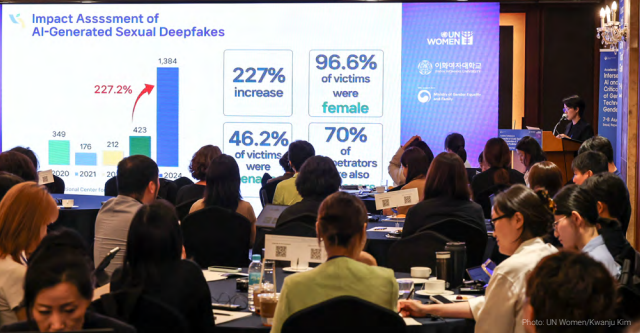
With just a few clicks, perpetrators can now fabricate explicit images and videos and circulate them at scale, targeting women and increasingly girls, including students in school communities. A new policy brief from UN Women warns that deepfakes and algorithm-driven misogyny are accelerating abuse faster than child protection systems, school safeguards and law enforcement can keep up.
The brief makes clear that generative AI is not simply transforming content creation. It is intensifying technology-facilitated gender-based violence in ways that are harder to trace, harder to remove and deeply harmful to children’s safety and dignity. For girls in particular, the creation and spread of non-consensual sexualized content can result in long-term psychological trauma, school withdrawal and social isolation.
Deepfakes are identified as a central threat. Synthetic sexual imagery is being weaponized against girls and young women, including students and young leaders, often without their knowledge. Once circulated, the damage can be immediate and irreversible, undermining a child’s right to privacy, protection and education.
The brief stresses that this abuse is no longer isolated. It is increasingly organized, supported by encrypted platforms, automated “deepfake bots” and business models that profit from scale.
In one cited example from the Republic of Korea, girls in schools and universities were systematically targeted, exposing how easily children can become victims in digitally connected environments while perpetrators remain anonymous and unaccountable.
Importantly, the brief links this surge in abuse to online communities that normalize misogyny and sexual exploitation, with harmful narratives amplified by recommendation algorithms. From a child safeguarding perspective, this ecosystem creates fertile ground for grooming, harassment and peer-on-peer abuse.
Yet the report also outlines solutions. It calls for using AI to protect children, including advanced detection tools, safeguards built directly into AI models and systems that degrade or block illicit content. It highlights AI-assisted takedown processes and round-the-clock counselling tools to support survivors and reduce barriers to reporting.
The central message is urgent: protecting children in the digital age requires coordinated global action, stronger child-focused laws, faster cross-border enforcement, digital literacy education and gender-responsive AI design that prioritizes children’s rights from the outset.