
What It Takes for Imperfect Parents to Raise Complete Children in an Imperfect World
#50PlusDad Reflections
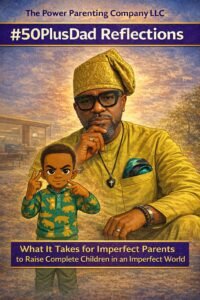
In the course of this week, I had a simple conversation with my wife, just ordinary talk. I said to her, “I love our son so much.” I meant it. I love him so deeply that some mornings I catch myself whispering it to myself: I just love him. I just love him.
And then the truth hits me: I am not a perfect lover. I cannot be. It is not possible.
I have loved my son from before he was born. Yet, in the four years since he arrived, I have not been perfect in my parenting. I have made mistakes. I still make mistakes. That is not self-pity; it is reality. I am not living in the delusion of trying to raise a “perfect child,” because I am not perfect. My wife is not perfect. No matter how hard we try, no matter how many books we read, the world does not have what it takes to produce, contain, or sustain perfection. The human condition itself is not built for it.
So what am I trying to do? What is my goal?
I am trying to raise a balanced child, a complete child.
That goal matters even more because of my own background. I grew up with abuse. There are parts of my childhood trauma that I still carry and work through daily. Whether I like it or not, some of that can rub off because trauma can live in reflexes, not just in memories.
Let me be clear: I do not beat my son. I do not yell at him. We discipline him, yes, but we do not abuse him. We are intentional about ensuring that our trauma does not become his inheritance. Still, I must admit something many people avoid admitting: some reflex actions were installed in childhood so deeply that they sit in the subconscious. No matter how self-aware you become, you may never fully identify every hidden trigger for as long as you live.
This is not only true for people with difficult childhoods. Even a “good childhood” is not perfect. And that is not an insult to our parents; it is simply the truth. Imperfect parenting can still raise balanced adults. Many of us are living proof.
But methods change.
Yesterday’s parents often used different methods to reach the same goal: a complete and balanced child. Today, the world has changed, completely. If today’s parents try to use yesterday’s methods to achieve yesterday’s good, many will find it falls flat. The principles may remain, the goals may remain, but the methods must adapt to the time.
So what does a balanced child look like?
A balanced child is raised with a clear understanding of personhood, that a child is not an object to manage, but a person to form.
1) A child is a person of worth
A child has value, not because of performance, but because of identity. We must raise children by affirming their worth. From my faith perspective, this is rooted in being made in the image and likeness of God. The worth of the child is not a negotiation. It is a foundation.
2) A child has judgment, the ability to think
We must raise children to think, both what to think and how to think. People say, “Don’t teach children what to think; teach them how to think.” I agree with the spirit of that statement, but I also know this: values must be taught. At the early stages, children need both values that shape what they think, and skills that shape how they think. As they mature toward independence, the “how” increasingly governs the “what,” but the early foundation matters.
3) A child has the power of choice
Children are making choices every day, small ones now, big ones later. We must train them to recognize that life is a function of choices, and that the sum total of your life is shaped by what you repeatedly choose. But choices do not float in the air; choices reflect values. Values shape choices. Past choices reveal values. This is why parenting cannot ignore values.
4) A child is a leader, today
Children are not merely leaders of tomorrow; they are leaders of today, in the measure that they can take responsibility. Leadership, at its core, is responsibility, owning actions, making amends, showing reliability, learning self-control.
These are major pillars of a complete child: worth, judgment, choice, responsibility.
And when we truly recognize the personhood of the child, we naturally begin to meet the deep needs every child carries. In my view, children need:
- Someone to believe (a stable voice of confidence)
- Something to believe (values and meaning)
- Somewhere to belong (identity and safety)
- Something to become (growth, purpose, direction)
- Someone to be (a real self, not a performance)
When these needs are honored, a child does not experience childhood as slavery, waiting for emancipation. Many children are counting down to freedom because they feel trapped under control rather than formed through love. Childhood is not slavery. It is a season of life, a season of development.
Now here is the part that keeps me grounded: because I know I am not perfect, I must take responsibility at the highest level. My imperfection forces humility. It forces reflection. It forces accountability.
But I also refuse to become enslaved to parenting.
I will not walk on eggshells, terrified of being wrong, until I become a prisoner of my own role. Parenting requires life, and life requires freedom, freedom of expression, freedom to learn, freedom to apologize, freedom to grow. Nothing good should enslave us, including a good mission.
Finally, I keep two truths close.
One is the principle: Train up a child in the way he should go, and when he is old he will not depart from it. That remains an anchor.
The second is realism: children will be children. Scripture puts it plainly: when I was a child, I spoke and acted like a child; maturity is a process.
That is my admonition as we approach the new year: aim not for perfection, but for wholeness. Raise not a “perfect child,” but a balanced one. And parent not as a slave to fear, but as a responsible human being, learning, growing, correcting, and loving.
Thank you.