
#50PlusDad Reflections
THE FIRST QUESTION MY SON ASKED ME ABOUT HIS SEXUALITY AND HOW I RESPONDED
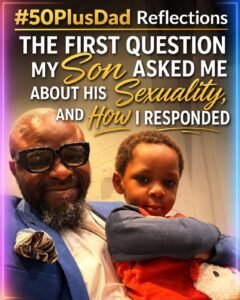
If I must talk to my child about life, I must talk to him about his sexuality. Not sex education I want to be precise. I am talking about sexuality: the physical and physiological makeup of a person. It is the core of his identity, and no honest conversation about who he is can sidestep it.
I knew this before our son arrived. The waiting period gave me the space to prepare, not only a curriculum, but a posture.
Why Most Parents Cannot Have This Conversation
The silence most parents keep around sexuality is rarely indifference. It is pain. Many parents had their innocence taken from them through childhood sexual abuse and that wound, unaddressed, does not simply fade. Let me be clear: time alone does not heal any wound. It is treatment plus time that heals. An abused person who never found help will find that any conversation about sexuality reopens the injury. So when a child comes asking, the father sends him to the mother. The mother sends him to the father. The child moves back and forth between two people carrying wounds they have never treated, and gets nothing.
I know this from the inside. I was sexually abused. I say that plainly. And I made a decision very early in my journey that I would commit to healing, not merely surviving. By the time our son came, I had already confronted the shame and the backlash of my own childhood. The pain has been addressed, though I remain in recovery. But I am in a good place. And that good place made a conversation I refused to avoid possible.
The Curriculum and the Approach
Sexuality education was non-negotiable in our home. If I must tell my son his name, I must also tell him about his sexuality. I have a curriculum, Every Part of My Body Is Private to Me and I have a timetable. But I made a deliberate choice: I was not going to sit him down and announce a lesson. I was going to let it happen, organically, over time. Deliberate, but not rigid. Structured, but never stiff.
I also decided something else: I was not going to introduce sexuality through my pain. My pain does not define sexuality. What happened to me does not define sexuality. Sexuality, as God made it, male and female he created them is beautiful. It is the essence of a person. I wanted my son to meet his identity as something beautiful, not as something to fear or guard with apprehension. I do not want him walking through life looking over his shoulder, convinced that predators lurk around every corner. What a person fears most has a tendency of finding them. I chose a different foundation.
So it began at bath time. From around age one, I started naming his body parts, simply, plainly, in the context of play. In the background, our song played: Every Part of My Body Is Private to Me. Before he could hold a full conversation, he already knew the song. That is not formal education. That is formation. And by the time he could speak, he already understood — every part of his body belongs to him, and no one has the right to touch it except for the purpose of care or appropriate affection.
The First Question
He was about three years old when he came to me and asked: Daddy, why am I a boy?
It was a small question in big clothes. He was not expressing dissatisfaction with being a boy. He was asking something larger, what is a boy? What makes me different? What does it mean? I understood that, and I chose to answer it fully.
I told him, first, that boys and girls are both members of the human race — and the human race is equal. Black, white, African, European: equal before God. Male and female: equal before God. That was my starting point, and I have never moved from it.
Then I told him about masculine strength. Men, in many societies, are defined by their strength. But I told my son plainly: the strength of a man exists for protection, not domination. A man who uses his strength to dominate has misunderstood the assignment entirely. I did not use the phrase “positive masculinity”, masculinity, rightly understood, does not require the qualification. The problem is not masculinity. The problem is our definition of it.
I told him that his gender is not a superiority contest. Being a boy gives him no automatic advantage in life. His results will be determined by his effort, not his biology. Dignity is in labour, in school, in character, in contribution. What he puts in is what he will get out, and no one will hand him anything on the basis of being male.
I told him that most of what society assigns to gender, this is for men, that is for women is not in the manual the Creator gave us. It is not science. Most differences between male and female are biological, physiological, and relational. The relational ones operate within specific contexts: in marriage, under the Judeo-Christian principles we hold, a man is the head of the home. But a man is not the head of every woman he encounters. He is not a leader in a room simply because he is male. Leadership at every level is determined by relationship and contribution. In some rooms, women hold the authority. In those rooms, everyone submits, including him. Some of the most powerful institutions in Nigeria are led by women. That is not an exception. That is reality.
Finally, I told him that the idea that men are logical and women are emotional is a lie we have told ourselves for too long. Every human being is a combination of emotion and logic. To acknowledge your emotions, to understand them, to direct them in the interest of those around you that is not weakness. That is one of the highest demands of being human. It is a demand made of him, too.
How We Had This Conversation
I did not deliver all of this in one sitting. I am not sure he would have endured it or me. I broke it into bite-size conversations across days, in the language of a child, woven into moments of life. I do not wait for him to be ready to understand before I speak. I speak ahead of his comprehension, knowing that what he hears consistently will accelerate what he eventually internalises. That is how children learn language. It is how they learn everything that matters.
The conversation about his sexuality is not a chapter we closed. It is a language we are learning to speak together and we began, as all good things begin, with a single honest question.
Join us for the EVERY PART OF MY BODY IS PRIVATE TO ME® Immersion
It draws from lived experience to equip parents, caregivers, and those in trusted roles with the understanding, language, and cultural tools to protect children, support healing, and fortify the environments children grow up in.
Join us In-Person:
📍 Abuja | Sunday, May 10, 2026 | 2:00 PM – 6:00 PM
📍 Port Harcourt | Sunday, May 17, 2026 | 2:00 PM – 6:00 PM
📍 Lagos | Sunday, June 1, 2026 | 2:00 PM – 6:00 PM
Register here: https://taiwoakinlami.com/epp2meImmersion