
China Expands Preschool Funding With $6.7B as Nigeria Struggles to Keep Schools Running
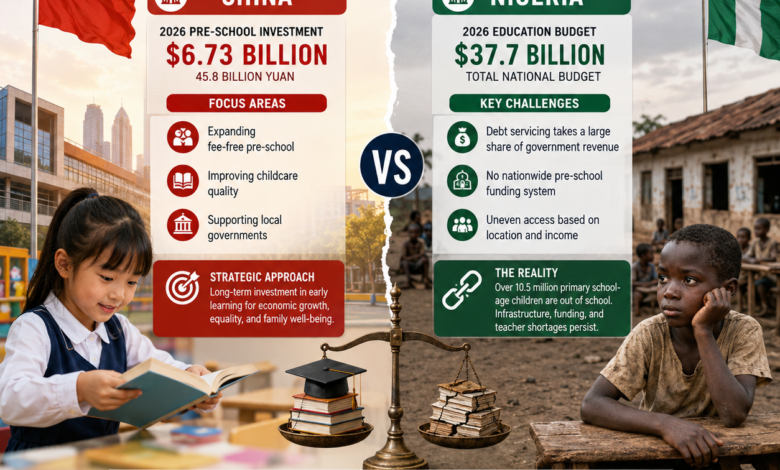
China’s recent investment in pre-school education has brought renewed global attention to how countries prioritise early childhood learning. In 2026, China allocated 45.8 billion yuan ($6.73 billion) to pre-school education nationwide. This reflects a growing focus on early learning as a foundation for national development. Nigeria, however, continues to face pressure on its education budget due to competing economic and social demands.
Although both countries recognise education as important, their funding scale, priorities, and delivery systems differ significantly.
A massive funding push in China, but what is driving it?
China increased its pre-school education funding to 45.8 billion yuan ($6.73 billion) in 2026. This represents a 38% increase compared to the previous year, according to state broadcaster CCTV and Reuters reporting.
The funding focuses on three main areas. First, expanding fee-free pre-school education. Second, improving childcare quality. Third, supporting local governments in delivering early education services.
This investment is part of a broader national strategy. China continues to strengthen early childhood systems, especially in rural and low-income areas. Millions of children have already benefited from expanded access to pre-school education.
China also treats early education as a long-term investment. Policymakers link it to economic growth, reduced inequality, and improved family wellbeing. As a result, early learning is integrated into national development planning.
Nigeria’s education system under pressure, but how deep is the strain?
Nigeria’s education system faces tighter fiscal constraints. Education spending competes with debt servicing, infrastructure, and security needs. This reduces the amount available for schools and learning programmes.
In its 2026 budget of about $37.7 billion, Nigeria allocated funds across multiple sectors. However, education remains under pressure due to limited revenue and rising national debt obligations.
Debt servicing continues to take a large share of government income. This limits investment in classrooms, teacher recruitment, and learning materials. As a result, education infrastructure often struggles to meet demand.
Unlike China, Nigeria does not operate a nationwide pre-school funding system. Early childhood education remains uneven. Access depends heavily on location, income level, and local government capacity.
Many public schools also face persistent challenges. These include overcrowded classrooms, limited learning materials, shortages of trained teachers, and weak early education infrastructure. These problems affect learning from the earliest stages.
Two systems, two paths, but where do they truly differ?
The most obvious difference is scale. China’s $6.73 billion pre-school investment alone shows a strong national commitment to early childhood education. Nigeria’s spending is more limited and spread across competing priorities.
China also uses a centralised approach. It directly subsidises pre-school education and fee reductions. Nigeria, in contrast, relies on fragmented federal, state, and local systems. This often creates uneven access.
Planning is another key difference. China integrates education into long-term national strategies. Nigeria’s funding decisions are more affected by short-term fiscal pressure and economic constraints.
Why This Is A Child Right Issue
From a child rights perspective, education is a basic entitlement. It is not a privilege. It is a right that should be accessible to every child without discrimination.
China’s investment reflects a structured approach to protecting early childhood development. It expands access, improves quality, and reduces financial barriers for families.
Nigeria, however, continues to face major challenges. The country has over 10.5 million primary school-age children out of school, according to the United Nations Children’s Fund. This raises serious concerns about the fulfilment of children’s right to education.
When children are out of school, their rights to development, protection, and future opportunity are also affected. Poor infrastructure and funding shortages deepen these inequalities.
Conclusion
China and Nigeria both recognise the importance of education, but their realities differ sharply.
China’s $6.73 billion pre-school investment in 2026 reflects a long-term, structured commitment to early childhood development. Nigeria, on the other hand, continues to face financial and structural challenges that limit consistent investment in education.
The comparison highlights an important global lesson. Early childhood education is not just a social service. It is a foundation for human capital, equality, and national progress.