CHILDREN’S DAY 2026: WHAT EXACTLY ARE WE CELEBRATING?
“There can be no keener revelation of a society’s soul than the way in which it treats its children.”
— Nelson Mandela
What exactly are we celebrating today?
Today, social media timelines are filled with colourful banners, smiling faces, cheerful greetings, and carefully designed messages wishing children a Happy Children’s Day.
But somewhere in Nigeria today, children who should be waking up in the warmth of their homes may be waking up in captivity.
Children who should be laughing with siblings, receiving gifts, wearing colourful clothes, and feeling loved may instead be wondering when they will see their parents again.
Children as young as two years old.
Children.
Not statistics.
Not headlines.
Children.
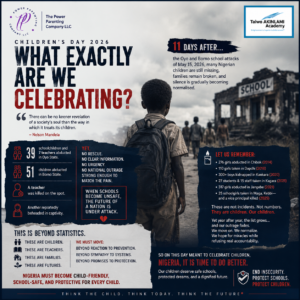
12 days after the Oyo and Borno school attacks of May 15, 2026, many Nigerian children remain missing. Families continue to live in uncertainty. Parents continue to wait. Homes continue to carry the weight of silence.
Thirty-nine schoolchildren and seven teachers abducted in Oyo State.
Fifty-one children abducted in Borno State.
A teacher killed on the spot.
Another reportedly beheaded in captivity.
Yet there remains a frightening possibility that we are already beginning to move on.
That is perhaps one of the greatest tragedies of all.
Because beyond the violence itself lies something equally dangerous.
Normalization.
We are becoming a nation that grieves briefly and forgets quickly.
We have learned how to continue our daily lives around the pain of children.
We have learned how to adjust to stories that should shake the conscience of a nation.
We have learned how to scroll past suffering.
We have learned how to live with the unacceptable.
Yet Mandela’s words confront us today with uncomfortable force:
“There can be no keener revelation of a society’s soul than the way in which it treats its children.”
If that is true, what exactly does our treatment of children reveal about us?
What does it reveal when schools become places parents fear?
What does it reveal when children disappear and silence follows?
What does it reveal when public discourse shifts quickly to politics while families remain suspended between hope and despair?
What does it reveal when political campaign conversations continue while children remain in captivity?
What does it reveal when those entrusted with responsibility speak softly while parents cry loudly?
Because there is something fundamentally broken about a society that can continue almost normally while children are still missing.
We remember Chibok.
Two hundred and seventy-six girls abducted.
We remember Dapchi.
One hundred and ten girls taken.
We remember Kankara.
More than three hundred boys kidnapped.
We remember Kagara.
Twenty-seven students and fifteen staff members taken.
We remember Jangebe.
Three hundred and seventeen girls abducted.
We remember Maga in Kebbi.
Twenty-five schoolgirls taken and a vice principal killed.
Each time, we said never again.
Each time, we mourned.
Each time, we promised.
Yet here we are again.
Another Children’s Day.
Another wound.
Another reminder that we have not learned enough.
No nation secures its future by abandoning its children.
No nation prospers while children learn fear before they learn safety.
No nation builds greatness while childhood itself remains under attack.
Today is not a celebration.
Today is a mirror.
And the reflection should disturb us.
Our hearts are with every child in captivity.
Our hearts are with every parent waiting for a phone call.
Our hearts are with every family carrying unbearable uncertainty.
Our hearts are with every teacher who continues to stand for children despite danger.
Nigeria must do more.
Beyond reaction.
Beyond speeches.
Beyond sympathy.
Beyond promises.
We must build a culture that protects children before tragedy occurs.
We must secure schools.
We must defend childhood.
We must safeguard the present and the future.
Because children are not merely the leaders of tomorrow.
They are our responsibility today.