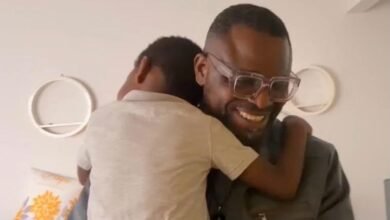
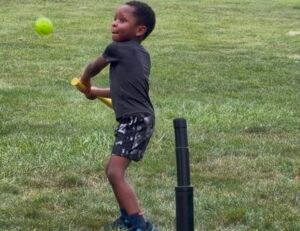
From the T-ball (Baseball) Field: Tieri, You Are the World
Two weeks ago, I wrote about taking Tieri to a park in New York and his unpleasant experience, which I turned into a positive and teachable moment.
This is another closely related experience, which I think is worth sharing.
He signed up for baseball. Every week I take him.
We had gone one evening like any other. The next morning, something moved in me to ask him: “So, how did you find your game? I hope it went well. I hope you enjoyed it.”
“Yes, Daddy, I enjoyed it,” he said. “But one of the children on the field told me I am the worst player he has ever seen trying to shoot baseball.”
I asked which child had said it. Then I told him:
“No. Don’t believe that. You are the best baseball shooter I have ever seen. That is Daddy’s opinion, and it matters, because I will never lie to you. You are the best.”
Then he asked the question every parent must one day answer: “Why would anybody say that to me?”
“Because people can be mean, yet it does not mean they are unkind,” I told him. “And it has nothing to do with you. Maybe he was having a bad day. It is about him, not about you. You do not take responsibility for who he is. You take responsibility for who you are.”
When I say I want to introduce my son to the world, I am not pretending the world is not mean. Bullies exist. Words meant to push down, to pull down, to wound, they exist. The child who said that to Tieri is not, to me, a wicked child. He is likely carrying home into the field, repeating what he hears. (I will still take it up with the organisers, because a field must be safe.) But that is not the heart of this reflection.
The heart is the lens.
I am building the inner furniture of my child. And I build it three ways.
The first is this: I am the first word he meets.
His mother and I are his first contact with the world.
So who we are to him is telling him who the world is to him.
This is why I call him what I say he is, and treat him as what I say he is.
I cannot call him beauty and treat him as ugly.
I cannot tell him I am kindness and hand him wickedness.
It informs the way I speak to him, with the respect his individuality deserves, though he is only four. I did not begin this today. From when he was small, I have listened to him. There is no moment he wants to tell me something and finds me unready to hear it. I cannot tell him his view matters and then shut him up when he speaks.
And so when I tell him he is the best, it is easy for him to believe me over a stranger, because my word has never lied to him, and my word has always been the one telling him who he is. A stranger’s word is strange to him. Mine is not.
The second is this: there is an open door between us, and I built it on purpose.
Notice how this whole reflection began: he told me. A four-year-old came home and handed his father the small wound another child had pressed into him.
That did not happen by accident.
A child will only open his mouth to someone whose ears he already trusts.
For years I have made myself that person, listening when it was inconvenient, taking his little reports seriously, never punishing him for the truth.
So when something finally hurt him, the path to me was already open. He did not have to build a bridge in a moment of pain; the bridge was already there.
This is the heart of safeguarding, and we forget it: we cannot protect a child above our relationship with him. All our policies, all our vigilance, all our watching from the edge of the field, none of it reaches the child who will not tell us what happened. Protection travels on the road of relationship, or it does not travel at all.
The third is this: he must be, to the world, what he wants the world to be to him.
He cannot afford to be the mean one.
He cannot afford to be the careless one.
He cannot afford to be the one who bullies.
He must be the change he wants to see, he must be the world he wants to live in.
Because you find what you are looking for. You attract who you are. If you carry a wicked lens, you will go through life hunting for wickedness, because that is what your eyes are trained to see.
But if you carry a beautiful lens, you will find beauty everywhere, because that is what lives in you first.
Scripture settled this long ago: “For as he thinketh in his heart, so is he” (Proverbs 23:7). What you see is what you get. And what you see begins with who you are.
Our elders said it in three small words: Ìwà l’ẹwà (character is beauty). The beauty a man finds in the world is the beauty he first carries within.
So this is what I am teaching Tieri, one field, one question, one bruise at a time:
The world is a beautiful place.
But you, my son, are the foundation of that beauty.
It is who you are that will decide what you see.
And it is what you see that will become what you get.
Be the beauty first.
Then go and find it everywhere.
And keep telling me everything
because the door between us
is the safest place you own.
Do have an INSPIRED week ahead with the family.