KING’S COLLEGE AT 117 IS SHUT AND THE CHILDREN ARE AT HOME
14 QUESTIONS NOBODY IS ASKING
A WORD BEFORE THE QUESTIONS
I have not slept well this week.
I have followed this controversy since July. On 16 September it came to a head, and I saw the images, a confrontation at a school gate, people on the ground, a protester taken away.
I am not writing about King’s College as a stranger reading newspapers. I have been in that school close to five times, invited year after year by the school leadership and by the Parent-Teachers Association. I have sat with the boys. I have sat with the teachers. I have done the same at Queen’s College, its sister school.
So this is personal.
The fourteen questions that follow are the product of sleepless nights, set against close to three decades of work in child safeguarding and family strengthening.
I offer them for consideration.
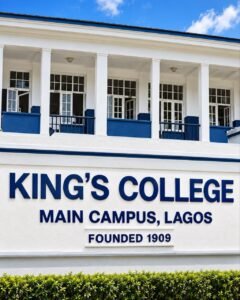
This Sunday, 20 September 2026, King’s College, Lagos, turns 117.
Yet its classrooms are empty, and its gates have become the scene of a dispute involving workers, parents, alumni and the police. Across more than a hundred Federal Unity Colleges from Onikan to Ahoada and Abuloma, the new academic session did not begin as planned.
Let us be clear about what that means.
Nigeria already has approximately 15 million out-of-school children by the Federal Government’s own recent estimate. Other estimates are higher because they use different age ranges and methodologies.
To that existing crisis, in September 2026, we added another group of children kept away from school, not by poverty, insurgency or any of the familiar tragedies we usually invoke, but because BECAUSE A CONCESSION PROCESS WAS MISMANAGED.
I have learnt to ask one question of every institutional crisis:
Where is the child in this?
Read the public statements issued in this matter. The Federal Government speaks of legal ownership, regulatory oversight and value-for-money assessments. The King’s College Old Boys’ Association speaks of rehabilitation, renaissance and a proposed investment of ₦100 billion.
Each is defending what it regards as a legitimate interest.
But who is defending the child?
HOW WE GOT HERE
The public record is brief and its brevity is part of the problem.
In July 2026, the King’s College Old Boys’ Association announced that the Federal Executive Council had approved a concession granting it management rights over the school.
On 28 August, parents and students protested on Lagos Island.
On 4 September, the Federal Ministry of Education wrote to the Principal, stating that the relevant processes had been concluded, the agreement signed and the handover directed to commence immediately. A Transition Committee was to complete the transfer within six months, after which funding from the Federation Account would cease. The Principal was also directed to provide a list of staff willing to remain in federal employment.
On 10 September, the unions issued a communiqué directing that the Federal Unity Colleges should not resume until the decision was reversed.
On 14 September, resumption failed nationwide.
On 15 September, workers and parents blocked access to King’s College. Members of the Old Boys’ Association who had come for a press conference were denied entry. The police intervened, and the encounter became confrontational.
The Association of Senior Civil Servants of Nigeria alleges that police officers forced the gate open, fired shots into the air, assaulted workers and parents, and arrested the son of a protesting parent.
Contemporary reporting confirms that at least two workers were seen on the ground during the confrontation and that at least one protester was taken away in a police vehicle.
By 16 September, police personnel had taken control of access to the premises.
Later that day, following talks with organised labour, the Federal Government suspended implementation of the concession for two weeks. It also stated that the arrangement would not be extended to other Federal Unity Colleges.
That suspension is welcome. But it is a pause, not an answer.
In barely two months, a proposal concerning a 117-year-old institution moved from announcement to a nationwide shutdown, confrontation and police intervention at a secondary school.
One fact in that chronology deserves particular attention. The unions say that they repeatedly sought an audience with the Minister of Education for more than a month and were not granted one.
The Federal Government has issued statement upon statement in this matter. It has explained legal title. It has explained value-for-money. I have seen no public response addressing that allegation.
Remember it when considering why this dispute escalated.
TWO FAILURES, AND A THIRD REQUEST
Government ordinarily performs two indispensable functions in education: it provides public education, and it regulates the education system.
In Nigeria, it has performed neither satisfactorily.
It has failed as a provider. Many public schools have deteriorated so severely that private education has become the practical default for families that can afford it.
That is an aberration, not an achievement.
Public education should remain the hope of the ordinary family. This is no indictment of private schools; many of them are addressing needs government created or neglected. But when the alternative becomes the norm, the public system has failed.
Government has also failed as a regulator. It has not maintained consistent standards across the private sector into which its own failures drove millions of families.
Now it asks Nigerians to trust it in a third role: managing the concession of one of the country’s most historic public schools.
Within two months, that process produced padlocked gates across the federation, a nationwide labour dispute, aggrieved parents and police intervention at a secondary school.
A government that cannot run a public school, and cannot regulate a private one, is now asking to be trusted to hand a public school over.**
And note where the constitutional responsibility lies.
Section 14(2)(b) of the Constitution provides that “the security and welfare of the people shall be the primary purpose of government.”
Not of unions.
Not of parents.
Not of alumni associations.
Of government.
So let us place responsibility where the Constitution places it.
This is not an argument against concessions as a matter of principle. It is an argument about competence, transparency, consultation and process.
Nigerians are not afraid of the letters “PPP.”
They are afraid of how public decisions are made and implemented in this country.
AND THE LAW IS NOT SILENT
Section 18 of the Constitution directs government, when practicable, to provide free, compulsory and universal primary education; free secondary education; free university education; and free adult literacy programmes.
Those provisions sit in Chapter II and are generally not directly enforceable by reason of section 6(6)(c), except where legislation or another enforceable provision gives them effect.
But the legal responsibility does not end there.
Section 2 of the Compulsory, Free Universal Basic Education Act requires government to provide free, compulsory and universal basic education for every child of primary- and junior-secondary-school age.
Section 15 of the Child Rights Act 2003 recognises every child’s right to free, compulsory and universal basic education.
Most importantly, section 1 of the Child Rights Act provides that:
In every action concerning a child, whether undertaken by an individual, public or private body, institutions or service, court of law, or administrative or legislative authority, the best interest of the child shall be the primary consideration.
Read that again:
Every action concerning a child.
And: the primary consideration.
That obligation is not addressed only to the Ministry.
It extends to every person, authority and institution whose decisions affect these children, including the Old Boys’ Association and the police.
Which brings me to the questions.
TO THE FEDERAL GOVERNMENT
1. THE ORIGIN AND THE RUSH
When did this proposal begin, and who participated in developing it? A decision affecting a 117-year-old public institution was announced in July and ordered into implementation in September. Why was the process conducted at that speed?
2. THE PROCESS AND THE HIDDEN AGREEMENT
Show Nigerians the process.
Was the concession openly tendered under Nigeria’s public-private-partnership framework, or was it negotiated directly with one named association? If it was directly negotiated, under what legal authority and following what procurement procedure?
And where is the concession agreement itself?
Government has published assurances, but not the controlling document. Why should Nigerians be expected to accept obligations contained in an agreement they have not been permitted to read?
3. THE MISSING CHILD-IMPACT ASSESSMENT
Government says the transaction underwent technical, economic, financial, legal, environmental and social assessments.
Where is the child-impact assessment?
Every assessment identified publicly is directed at the viability of the transaction. Which one considered the immediate and long-term effects on the children?
4. THE FUTURE OF FEES AND FEDERAL FUNDING
What happens after the six-month transition, when funding from the Federation Account stops?
Legal ownership may remain with the Federal Government while the financial burden migrates to parents. Saying “it is not a sale” does not answer that question.
What will the fee structure be in year two, year five and year ten?
5. THE FUTURE OF THE UNITY-COLLEGE MANDATE
Federal Unity Colleges were established to give children from different states, regions, ethnic communities and socioeconomic backgrounds access to education in a shared national environment.
What binding and enforceable provisions preserve that character?
What remedy will parents have if those provisions are breached?
6. WILL OTHER UNITY COLLEGES BE NEXT?
The Federal Government has now said the King’s College arrangement will not be extended to other Unity Colleges.
Is that assurance contained in any binding policy or instrument or is it a statement made in response to the present crisis?
7. THE MEETING THAT DID NOT HAPPEN
Did the unions repeatedly seek a meeting with the Minister for more than a month?
If so, who decided not to meet them?
Does anyone in government accept that the failure to engage early contributed to padlocked gates across the federation?
TO THE KING’S COLLEGE OLD BOYS’ ASSOCIATION
8. WHO WILL GOVERN THE GOVERNORS?
What governance, accountability and conflict-of-interest safeguards will regulate the Association’s exercise of management power?
Who will appoint the school’s managers, approve expenditure and monitor performance and to whom will those decision-makers answer?
9. WHERE WERE THE PARENTS AND THE CHILDREN?
Before accepting management responsibility, did the Association consult the parents whose children it proposes to manage?
Did it consult the boys themselves?
10. WHY MUST SUPPORT REQUIRE CONTROL?
The Association has undertaken to finance, rehabilitate, modernise, operate and maintain the school.
If love for King’s College is the principal motivation, why must that commitment depend upon receiving management rights?
What prevented the Association from funding classrooms, laboratories, hostels and scholarships while the school remained under its existing management structure?
11. CAN ANY CHILD BE PRICED OUT?
Will the Association make a legally enforceable commitment, not merely a public assurance, that no child currently enrolled at King’s College will be priced out of the school under its management?
TWO ELEPHANTS, AND THE GRASS
There is an African proverb we all know:
When two elephants fight, the grass suffers.
What we sometimes forget is its less frequently quoted extension:
When two elephants make love, the grass suffers just the same.
Here are the two elephants.
The Federal Government, with the power of public office and federal authority.
The King’s College Old Boys’ Association, with its proposed ₦100 billion and its access to power.
Whether they are fighting or dancing, the danger to the grass remains the same.
And the grass is everyone else:
The children.
Their parents.
The workers.
That is why I will not direct my questions at the grass.
When a household believes its home is being invaded, the first question is not why the family barricaded the door. The first question is what happened to make the family believe that barricading the door was its only remaining option.
I have heard the argument that the unions should not have prevented the schools from reopening.
Then let those who make it answer a further question: what meaningful channel of engagement was made available before the shutdown?
They asked to be heard for more than a month. They were refused. They then learnt that an agreement affecting their employment, and a school some of them have served for decades, had already been signed.
What effective instrument were they left with?
That does not justify keeping children out of school. Every day those gates remain closed, children lose instructional time they may never fully recover.
But responsibility for that loss does not rest solely on those who locked the gates. It rests also with those who designed and managed a process in which the affected stakeholders say they were neither consulted nor heard.
And there is one party with the clearest capacity to end this impasse: the Federal Government.
It can begin by doing what should have been done before implementation commenced, sitting down transparently with the people whose lives and institutions its decision will rearrange.
AND FOR THE GRASS: THREE QUESTIONS, NOT TO THEM, BUT FOR THEM
12. FOR THE PARENTS: WHAT OPTION WERE THEY GIVEN?
What precisely were the parents expected to do?
They protested on Lagos Island on 28 August. They returned to the gate on 15 September and encountered the police. They are the constituency with the most immediate and unambiguous stake in this school, their own sons, yet they had no seat in the process.
When parents are given no meaningful forum, inadequate notice and no access to the governing document, what avenue remains open to them?
13. FOR THE CHILDREN: WHEN WILL ANYONE ASK THEM?
Some King’s College boys appeared on Lagos Island with placards on 28 August, because protest seemed to be the only available means of being heard.
Children should never be used as instruments in adult disputes. But a child who is denied every proper channel of participation, and then criticised for using the only one left, has been failed twice. You beat a child, and then you complain that the child is crying.
When will anyone formally ask a King’s College boy what he thinks about the future of King’s College before decisions are concluded, rather than after agreements are signed?
14. FOR ALL OF US: WHAT HAPPENED AT THE SCHOOL GATE?
The police intervened at the gate of a secondary school. Workers were seen on the ground, and at least one protester was taken away in a police vehicle.
The unions allege that shots were fired, that people were assaulted, and that the son of a protesting parent was arrested. The police account and the protesters’ account are not identical.
There must therefore be an independent and publicly available account of what happened at Onikan on 15 September.
The identity, age, legal status and present whereabouts of every person detained in connection with that incident must also be disclosed in accordance with the law.
A school gate is not a battlefield.
WHAT SHOULD HAPPEN NOW
RETURN THE CHILDREN TO CLASS IMMEDIATELY AND UNCONDITIONALLY
Adults can negotiate while children learn. Nothing in this dispute is improved by an empty classroom. The two-week suspension must be used to restore learning, not merely to postpone the argument.
PUBLISH THE AGREEMENT
The public cannot evaluate a concession whose controlling terms remain undisclosed.
CONDUCT AN INDEPENDENT CHILD-IMPACT ASSESSMENT BEFORE IMPLEMENTATION
And make such an assessment a standing requirement for every proposed concession or fundamental restructuring of a public school in Nigeria.
If this crisis produces one reform that survives the news cycle, let it be this.
HEAR THE PARENTS, THE WORKERS AND THE CHILDREN
Consultation after an agreement has been signed is not participation.
Placards on Lagos Island are not participation either. They are what participation looks like after participation has been denied.
INVESTIGATE THE EVENTS OF 15 SEPTEMBER
Establish what force was used, by whom, against whom and under what authority.
Account publicly for every person arrested or detained.
King’s College turns 117 on Sunday.
It has outlasted colonial rule, civil war and successive governments. It will outlast this controversy too.
But the children will not get this term back.
Think the child. Think today. Think the future.
Enlightenment is Superior to Enforcement®
Follower of Christ. Husband. Father. Egalitarian. Goodwill Investor. Attorney. Author. Thriver. Culture-Edge Family Strengthening and Child Safeguarding Pioneer, Innovator and Practitioner. Value-Based Parenting Ideologue. Change Agent. Rebel with a Cause. Three Decades in the Saddle.