Why Youth Sports Development in Nigeria Is Non-Negotiable
Episode One: Who Is Discovering the Next Generation of Winners?
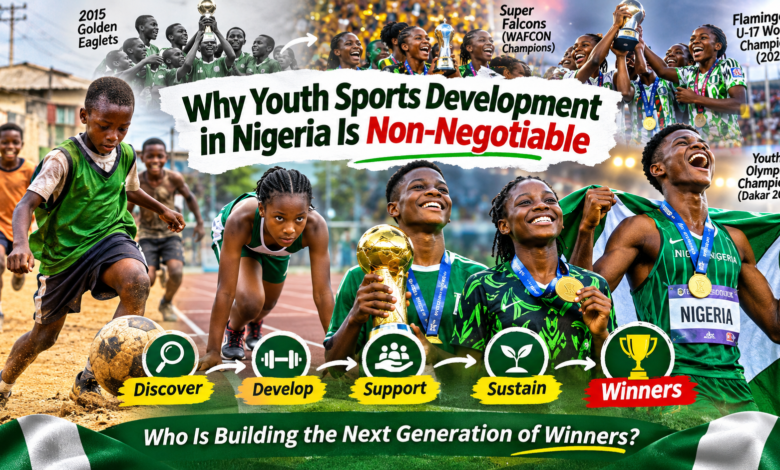
For a country with approximately 81 million people between the ages of 10 and 24, Nigeria has endured more than its fair share of sporting heartbreaks in recent years. According to the United Nations Population Fund (UNFPA), this age group accounted for 34 per cent of Nigeria’s estimated 237.5 million population in 2025. Interestingly, these figures do not even include the millions of children below the age of ten.
With such an enormous population of children and young people, one would ordinarily expect Nigeria to have a steady supply of sporting talents capable of competing with the best in the world.
After all, if there is one thing Nigerians are passionate about, it is sport, particularly football. We argue about team selections, criticise coaches, analyse matches and sometimes appear to understand football better than the people employed to manage it.
Unfortunately, our enthusiasm has not always translated into success on the pitch.
The Super Eagles have not lifted the Africa Cup of Nations (AFCON) trophy since 2013. Although they came close in the 2023 edition, finishing second, and secured third place at the 2025 tournament, the continental crown has remained beyond their reach.
Even more painful is the fact that the last time Nigeria participated in the men’s FIFA World Cup was in Russia in 2018. We missed Qatar 2022, and our hopes of returning to the global stage in 2026 were dashed when DR Congo defeated the Super Eagles on penalties in the African play-offs in November 2025.
For a country that regards football as a significant part of its national identity, missing two consecutive World Cups is certainly not something to celebrate.
Then came the nominations for the 2026 Confederation of African Football (CAF) Awards.
Not a single Nigerian made the shortlist across the seven men’s award categories. Victor Osimhen, who won African Player of the Year in 2023, and Ademola Lookman, who succeeded him in 2024, were both absent.
To make matters even more interesting, Nigeria is hosting the awards ceremony in Lagos on 2 December 2026.
Imagine hosting a celebration of African football excellence without a Nigerian nominee in any of the men’s categories.
Thankfully, the women’s categories tell a different story. The Super Falcons, Christiana Uzoma, Seimeyeha Janet Akekoromowei and Oluwakemi Adegbuyi have received nominations.
Of course, award nominations are not the only measure of a country’s football development. Nevertheless, our absence from the men’s categories, coming after another failed World Cup qualification campaign, should give us something to think about.
Young Champions Are Keeping Nigeria’s Sporting Hopes Alive
Just when it appears that Nigerian sport has become a catalogue of disappointments, our women and young athletes have continued to remind us that all hope is not lost.
The Super Falcons won the Women’s Africa Cup of Nations in 2018 and again in July 2025, defeating hosts Morocco 3–2 in a remarkable comeback to claim their tenth continental title.
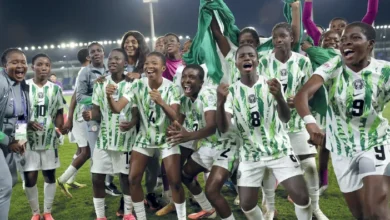
Then, on 7 November 2026, the Flamingos made history in Morocco.
Nigeria defeated Japan 2–1 to win the FIFA U-17 Women’s World Cup, becoming the first African women’s team to win a FIFA world title at any age level.
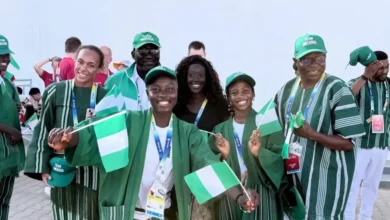
As Nigerians were still celebrating that achievement, another set of young champions was making headlines at the Dakar 2026 Youth Olympic Games in Senegal.
On 8 November, 15-year-old Gift Bright won the men’s 100 metres in 10.28 seconds, setting a Youth Olympic Games record. Rosemary Nwankwo completed Nigeria’s sprint double by winning the women’s 100 metres in 11.16 seconds.
The following day, Praise Ugoh claimed gold in the women’s 400 metres, finishing in 52.76 seconds.
Three young Nigerians, three sprint gold medals, and another reminder of the sporting potential within the country.
Interestingly, Nigeria had earlier finished seventh at the 2026 Commonwealth Games in Glasgow, winning 24 medals, including ten gold, across athletics, weightlifting, para sports and judo.
These victories deserve every celebration they receive. They also demonstrate that Nigeria has not lost its ability to compete successfully on the international stage.
But there is one question we hardly ask when the celebrations are over.
What happens to these young champions after they have conquered the world for Nigeria?
This is not a debate about gender imbalance in sport or whether Nigerian male athletes are less committed than their female counterparts.
The problem is deeper than that.
Nigeria has children with remarkable sporting potential. What we have yet to establish consistently is a dependable system for discovering those abilities, developing them and ensuring that promising athletes receive the support necessary to succeed as adults.
And to understand why this matters, we need to revisit a group of boys who made the entire country proud eleven years ago.
The 2015 Golden Eaglets: Where Is That Generation Today?
In 2015, Nigeria travelled to Chile and conquered the world.
The Golden Eaglets defeated Mali 2–0 in the final of the FIFA U-17 World Cup, winning the trophy for a record fifth time.
That squad included Victor Osimhen, who scored ten goals during the tournament, Samuel Chukwueze, whose performances earned him the Bronze Ball, and captain Kelechi Nwakali, who emerged as the tournament’s best player.
For a country already accustomed to winning youth football championships, another generation of exceptional players appeared to have arrived.
Eleven years later, Osimhen and Chukwueze have established themselves in senior international football, while Nwakali has also represented the Super Eagles.
But what happened to the others?
How many successfully progressed through the under-20 and under-23 national teams? How many eventually represented the Super Eagles? How many received the necessary support to develop professional careers, and what became of those who struggled along the way?
These questions are not intended to suggest that every member of the 2015 squad should have become an international superstar.
Football does not work that way.
Some young players develop faster than others. Injuries happen, careers take different directions, and not everyone who performs exceptionally at 17 will become an outstanding player at 27.
However, the responsibility of a serious sporting system is to create opportunities for promising young athletes to progress, regardless of whether they eventually become international stars.
It is not even about keeping the same players together indefinitely. It is about ensuring that the pathway from youth football to senior competition is properly structured and accessible.
Nigeria won the FIFA U-17 World Cup in 2013 and successfully defended the title in 2015. Now, in 2026, the Flamingos have added another historic youth football achievement.
Clearly, we have produced winning generations before.
But who is responsible for ensuring that these generations do not disappear from the national sporting conversation once their tournaments are over?
Today, the Flamingos are world champions. Congratulations will be offered, celebrations will take place, and promises may be made.
There is nothing wrong with any of that.
But who is already planning their transition into senior football? Who will monitor their educational progress, professional development and welfare? How many of these girls will eventually have the opportunity to represent the Super Falcons?
Ten years from now, will we still be celebrating their achievements, or will we be asking the same questions we are asking about the 2015 Golden Eaglets?
Unfortunately, our concerns do not even begin with what happens after a young athlete wins a championship.
They begin much earlier.
The Talents Nigeria Has Yet to Discover
Perhaps Nigeria’s greatest sporting challenge is not even the development of talent after discovery. It is that we have yet to establish a comprehensive and consistent system for discovering sporting abilities among children in the first place.
Think about it.
How many Nigerian children have exceptional sporting potential but have never participated in a properly organised competition?
How many talented footballers spend their afternoons playing on community fields without ever being observed by a qualified coach or scout?
How many potential sprinters, swimmers, boxers and basketball players are sitting in classrooms without knowing that they possess abilities that could be developed through sport?
The answer is simple. We do not know.
And that is part of the problem.
The children who eventually represent Nigeria are not necessarily the only talented children in the country. They are among those who managed to find opportunities to demonstrate and develop their abilities.
Others may never have had that opportunity.
A child could be exceptionally fast but attend a school without an athletics programme. Another could have the coordination and physical abilities suited to basketball but live in a community without a basketball court.
How would anyone discover these abilities if there are no opportunities to explore them?
For many Nigerian children, inter-house sports competitions remain one of the few organised sporting activities available within their schools.
A child wins the 100-metre race, receives applause, perhaps gets a medal, and returns to class.
The following year, another competition is organised.
But what happened during the twelve months between those events?
Was the child offered additional training? Did anyone assess their potential? Were there opportunities to compete against children from other schools?
Or did the entire experience end with the announcement of the winner?
This is not to suggest that Nigeria has no sports academies, school competitions or grassroots programmes. Such initiatives exist, and many passionate coaches continue to work with young athletes, sometimes under difficult circumstances.
The concern is that these opportunities are not sufficiently coordinated or accessible to children across the country.
Talent discovery should not depend mainly on chance, family connections or a child’s ability to attend a privately funded academy.
A country with Nigeria’s population should have an organised process through which children can participate in sport and those who demonstrate particular abilities can receive further opportunities.
That means taking physical education seriously, organising regular competitions and ensuring that qualified coaches can reach children in urban and rural communities.
It also means recognising that talent identification should not depend on a single performance.
Some children mature earlier, while others develop their abilities much later. A child who does not win a race at eleven may still become an exceptional athlete with appropriate training.
This is why sports development must create opportunities for continuous participation rather than limiting attention to children who appear outstanding at an early age.
We cannot develop talents we have failed to discover, and we cannot consistently produce champions without creating opportunities for children to learn, compete and improve.
As Nigeria celebrates the Flamingos and its young Olympic champions, we must therefore look beyond the children who have already made headlines.
Somewhere in the country, another generation of potential champions may be growing up without a single opportunity to demonstrate what they can do.
Who is looking for them? And if we eventually discover them, do we have what it takes to develop and protect them?
Those questions lead us to the second part of this conversation.
In Episode Two, we examine why early sporting development matters, how poor administration and athlete welfare have affected Nigerian sport, and what the country must do to build a system capable of producing and sustaining champions.