Prince George Heads to Eton: The $80,000 Elite School, His Father’s Legacy, and the Values That Shape a Child
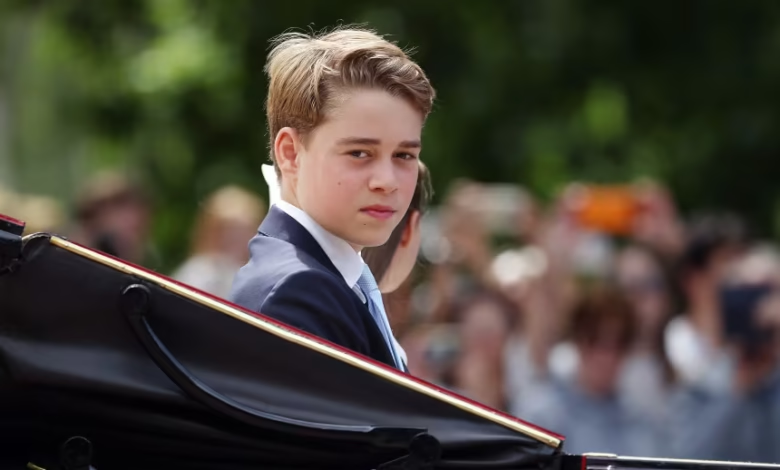
Britain’s Prince George, second in line to the British throne, is expected to begin his next educational chapter at Eton College in September 2026, according to confirmation from Kensington Palace reported by major international media.
Eton is one of Britain’s most prestigious schools, founded in 1440, and currently charges fees reported at more than £60,000 per year, approximately $80,000 to $85,000 depending on conversion. The school has educated members of Britain’s elite, including Prince George’s father, Prince William, his uncle, Prince Harry, and several British prime ministers. (Reuters)
On the surface, this is a royal education story.
But from a child-focused, safeguarding, protection, and values-inculcation perspective, it is more than that.
It is a story about how families, institutions, traditions, and social systems shape children long before those children fully understand the weight of the worlds into which they are born.
Prince George is not merely going to “a school.” He is entering an institution with history, class meaning, national symbolism, and inherited expectations. Eton is not just an academic environment; it is a culture-forming institution. It teaches subjects, but it also transmits values, networks, traditions, confidence, codes of conduct, and a particular understanding of leadership.
That is why the father’s attendance matters.
Prince William entered Eton in 1995, becoming the first senior royal in his direct line to attend the school, breaking from the earlier royal pattern associated with Gordonstoun, the school attended by King Charles. Reports indicate that William has spoken positively about his time at Eton, which was also close enough to Windsor Castle to allow weekend contact with Queen Elizabeth II. (Reuters)
Now his son follows.
This is where the real child-development question begins: when a child follows the educational path of a parent, what exactly is being passed down?
A school can pass down discipline.
A school can pass down identity.
A school can pass down confidence.
A school can pass down entitlement.
A school can pass down service.
A school can pass down privilege without responsibility.
A school can also pass down privilege with accountability.
The difference lies in values.
For those of us committed to child safeguarding and protection, education must never be reduced to fees, fame, examinations, elite status, or institutional prestige. The more important question is not simply, “Where is the child being educated?” The deeper question is, “What kind of human being is this education forming?”
A child may attend the most expensive school in the world and still not be taught empathy.
A child may sit in historic classrooms and still not learn responsibility.
A child may inherit public visibility and still not be protected from pressure, isolation, anxiety, entitlement, or emotional neglect.
This is why child safeguarding must include values safeguarding.
It is not enough to protect children from obvious harm. We must also protect the moral, emotional, relational, and psychological architecture of their childhood. Children are shaped not only by what adults say to them, but by what adults normalize around them.
When adults normalize class superiority, children learn hierarchy.
When adults normalize service, children learn duty.
When adults normalize silence, children learn suppression.
When adults normalize accountability, children learn character.
Prince George’s move to Eton should therefore not be viewed only as a royal tradition story. It should also invite a broader reflection on every child’s right to an education that forms character, protects dignity, nurtures empathy, and prepares the child not merely to succeed, but to serve.
This principle applies whether the child is a prince in Britain, a pupil in a private school in Nigeria, a child in a public school in America, or a child learning under a tree in a forgotten rural community.
The environment may differ.
The safeguarding question remains the same:
Who is shaping the child?
What values are being planted?
What culture is being normalized?
What pressure is being hidden behind prestige?
What responsibility comes with privilege?
Prince George’s schooling will naturally attract global attention because of who he is. But every child’s formation deserves serious attention, whether or not the world is watching.
For child-focused platforms, the lesson is clear: education is never neutral. Every school is a value-incubation system. Every family is a culture-transmission system. Every institution that receives a child becomes part of that child’s safeguarding environment.
Therefore, the issue is not Eton alone.
The issue is the kind of adults we expect schools, families, and societies to raise.
A child’s school may open doors.
But only values can teach the child what to do with the power waiting behind those doors.
Final Reflection
Prince George may be heading to Eton, the elite school his father attended.
But the greater question for all children is this:
Are we merely preparing them to inherit status, or are we preparing them to carry responsibility with character?
That is where true safeguarding begins.