
Nigeria’s Schools Under Siege: A Nation’s Children Held Hostage
When classrooms become targets, an entire generation hangs in the balance
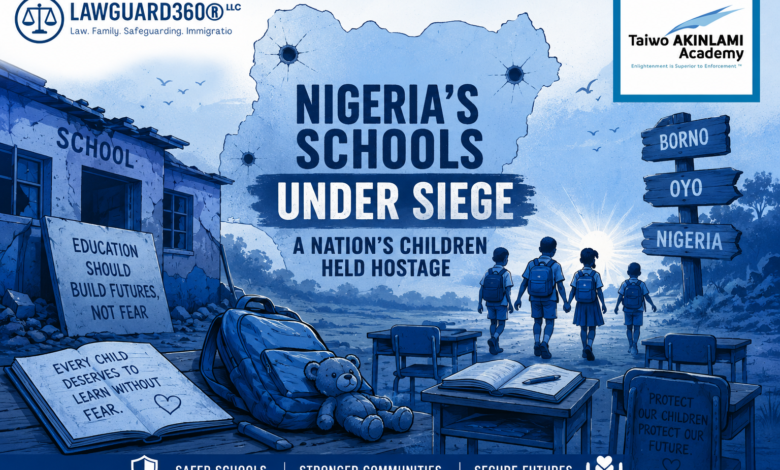
In the span of a single week in May 2026, armed militants stormed schools across two of Nigeria’s geographically opposite states; the conflict-scarred northeast and the comparatively peaceful southwest abducting more than 80 children and killing at least one teacher. The attacks were a brutal reminder that Nigeria’s school kidnapping crisis is no longer a regional problem. It is a national emergency.
The pattern is now tragically familiar. Gunmen arrive. Children scatter. Some are taken. Officials condemn. Promises are made. And then in the words of Amnesty International “authorities never fulfill promises to investigate the incidents and bring the perpetrators to justice.”
A Week of Terror, From Borno to Oyo
Between Wednesday and Thursday of last week, suspected militants linked to Boko Haram and its splinter affiliate, the Islamic State West Africa Province (ISWAP), descended on a primary school in the village of Mussa, near Sambisa Forest in Borno State, long the epicentre of jihadist violence in Nigeria’s northeast. Forty-two children were abducted.
The ink had barely dried on the headlines before, on Friday, two secondary schools in Oriire Local Council of Oyo State, over 1,000 kilometres away from Borno, in southwestern Nigeria were attacked within hours of each other. Estimates of the number of children abducted from Oyo range from 39 to 48, with officials still reconciling figures at the time of writing.
What made the Oyo attack particularly chilling was its geography. Mass school abductions of this kind are rare in the southwest. If anything confirmed that Nigeria’s security crisis has metastasised beyond the north, it was the sight of gunmen operating with lethal efficiency in a state many Nigerians had considered relatively safe.
The human cost was immediate and horrifying. One teacher, identified as Michael Oyedokun, was reportedly beheaded by the abductors, a graphic video of his killing circulating on social media and inflaming grief and outrage across the country. His assistant headmaster, who attempted to shield students from the attackers, also reportedly lost his life. Three suspects have since been detained by police in connection with the Oyo attack, but authorities have not indicated whether ransom demands have been made or whether the children are close to recovery.
A Decade of Abductions, A Pattern of Failure
Nigeria’s school kidnapping crisis did not begin this week. Its most infamous chapter opened in April 2014, when 276 schoolgirls were abducted from a government secondary school in Chibok, Borno State, by Boko Haram, an act that launched the global #BringBackOurGirls movement and briefly focused the world’s attention on Nigeria’s insurgency. In the years since, the abductions have continued with grim regularity: Dapchi in 2018, Kankara and Kagara in 2020 and 2021, Kebbi and Niger states in late 2025, and now Borno and Oyo in 2026.
Amnesty International has documented at least 15 mass abductions of schoolchildren since Chibok, a figure that the organisation warns, likely understates the true scale of the problem. The cumulative effect has been devastating. Twenty thousand schools or more have been shuttered across seven states at various points. Many, closed as emergency protective measures after attacks, were never reopened. The children who attended them were offered no alternative education.
Security analysts point to a grim logic behind the targeting of schools. Armed gangs whether ideologically motivated jihadist groups or criminal networks primarily interested in ransom recognise schools as soft, strategic targets: high in symbolic value, low in security infrastructure, and virtually guaranteed to generate the attention and leverage needed to extract demands from governments and desperate families.
The Ripple Effects: Fear, Forced Marriage, and a Generation at Risk
The consequences of the crisis extend far beyond the immediate trauma of abduction. Amnesty International has warned that the mere threat of kidnapping is driving children out of school across affected regions. In many communities, families unable to count on state protection are pulling daughters from classrooms and marrying them off early, reasoning that a child at home is safer than a child at school.
In Oyo, the day after the attacks, classrooms sat empty. Teachers staged peaceful protests through the streets of Oriire, carrying placards and singing solidarity songs, demanding that authorities secure the release of their colleagues and students. Farmers said they were afraid to go to their fields. Traders said they feared travelling. A community once described as relatively secure had been plunged into the paralysis of fear that northern Nigerians have endured for years.
Mental health professionals and education advocates are raising alarms about the long-term psychological damage being inflicted on children who live under the shadow of potential abduction whether or not they are ever taken. Anxiety, trauma, and educational disruption compound across generations, weakening communities long after individual attacks fade from headlines.
Accountability Gap: Where Does the Money Go?
Among the most urgent and unsettling questions surrounding Nigeria’s school security crisis is the matter of accountability. The Human Rights Writers Association of Nigeria (HURIWA) has called on the federal and state governments to publicly account for all funds, grants, and donor-supported interventions expended on school safety initiatives over the years.
The organisation’s charge is pointed: “Nigerians cannot continue to witness mass abductions while billions allegedly allocated for protection vanish into opaque bureaucratic channels with no visible impact on ground security.” It is a charge that has gone largely unanswered. After each attack, investigations are promised. After each promise, silence follows.
This accountability gap is not merely a governance failure, it is a moral one. When the state loses the capacity to protect children in classrooms, it surrenders what HURIWA describes as “one of its most sacred responsibilities.” The legitimacy of government, at its most fundamental level, rests on the safety of its citizens. On that measure, successive administrations have fallen short.
The International Response: Concern Without Consequence
The United Nations has expressed alarm. Spokesperson Stéphane Dujarric confirmed that Secretary-General António Guterres is concerned about extremist attacks on places of education in Nigeria, noting that the UN country team has been working with the government to make schools safer. The statement was measured, diplomatic and, to many Nigerians, achingly familiar in its limitations.
International concern has been a constant feature of Nigeria’s school kidnapping crisis since Chibok. What has been notably absent is the kind of sustained, structural international pressure on funding, governance, and security reform that might produce change rather than mere commentary.
The Christian Association of Nigeria (CAN), through its President Archbishop Daniel Okoh, captured the prevailing national sentiment plainly: it is “intolerable, disgraceful and utterly unacceptable” that Nigerian children cannot sit safely in classrooms. “This is not merely another security incident,” Okoh said. “It is a national disgrace.”
What Must Change
The solutions demanded by analysts, civil society groups, and education advocates converge on several urgent fronts.
- Government accountability must be enforced through transparent, public reporting on school security expenditure, independent investigation of all abductions since 2014, and meaningful prosecution of perpetrators rather than the revolving cycle of arrests and silence.
- Security infrastructure in rural and underserved communities must be radically improved. Ungoverned spaces; forests, borderlands, and areas of limited state presence cannot continue to serve as staging grounds for attacks. This requires sustained military and intelligence investment, not episodic operations.
- Comprehensive trauma support for survivors, families, and school communities must be treated as a priority, not an afterthought. Children and teachers who have experienced violence require psychological care that the state has so far largely failed to provide.
- Education continuity must be guaranteed even when schools are temporarily closed. Indefinitely shuttered schools are not a security solution they are a secondary catastrophe, compounding the damage done by the attacks themselves.
- Teacher and union mobilisation deserves serious consideration. Calls have been made for Nigeria’s teachers’ unions to demand empirical, verifiable security guarantees from government before returning members to classrooms. The safety of teachers and the safety of children are inseparable and treating educators as expendable serves neither.
The Reckoning Nigeria Cannot Afford to Delay
The abductions in Borno and Oyo in May 2026 are not anomalies. They are data points in a long and devastating trend. What they confirm with renewed urgency is that the problem has outgrown the regional frameworks in which it was once analysed and addressed. No state is immune. No school should consider itself safe without deliberate, enforced protection.
Nigeria’s children go to school to build a future. Their teachers go to give them one. Both are now doing so under the shadow of violence, in classrooms where fear has displaced learning, and where the state’s absence is felt as acutely as any armed attacker.
The children of Nigeria deserve better. The teachers of Nigeria deserve better. A nation that cannot protect either has a crisis it can no longer afford to manage incrementally or mourn one attack at a time.