
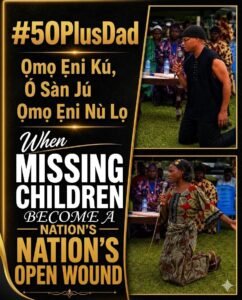
I took a break from this column last week. It was not because my heart was not there. It was because my heart was perhaps too much there. I was in the middle of so much, and though the subject had been pressing heavily on me, I could not bring myself to write. This week, I return to it because there are matters we cannot keep postponing, especially when the matter concerns the safety, dignity, and future of our precious children.
There is an old Yoruba proverb that says, “Ọmọ ẹni kú, ó sàn jú ọmọ ẹni nù lọ.” Literally, it means that it is better for one’s child to die than for one’s child to be lost. At first hearing, the proverb sounds harsh, even cruel. No parent wishes for the death of a child. No parent prays to bury a child.
The death of a child is one of the deepest tragedies any human being can experience. I once listened to a mother who lost her child at about six years old. Many years later, when the child would have been around fifteen, she said the pain remained a burden she would carry to her grave. That statement has never left me. It tells us that when a child dies, something in the parent also dies, even if the parent continues to live.
Yet, Yoruba philosophy still dares to say that a dead child is better than a missing child. Why? Not because death is desirable. Not because death is light. Not because the grave is kind. The point, I believe, is closure. When a child dies, as terrible and unbearable as it is, there is certainty. There is mourning. There is burial. There is a grave. The heart is broken, but it knows what has happened.
When a child goes missing, however, the wound remains permanently open. There is no certainty. There is no closure. Every sound may be news. Every phone call may be the call. Every passing day becomes another argument between hope and despair. Weeks become months. Months may become years. The parent is forced to live in a corridor between life and death, unable to mourn fully and unable to rejoice.
But I believe the proverb goes even deeper than the emotional agony of uncertainty. In Yoruba thought, a lost child is not merely a child who cannot be found. A lost child is a child who has passed beyond the reach of protection. A lost child is a child whom the family, the community, the system, and the nation have failed to keep safe.
To my mind, this is the deeper meaning of the proverb: an unprotected and unsafeguarded child is as good as dead, even while living. Such a child has been abandoned to chance, exposed to dangers from which responsible adults, institutions, and the State ought to have shielded him or her. A society that fails to protect its children places them in a condition no child should ever have to endure.
It raises questions that no serious society should run away from. Who was responsible for protecting the child? Who was responsible for creating an environment where the child could be safe? Who was responsible for ensuring that if danger came, there would be machinery on the ground to respond immediately and effectively? Who was responsible for rescuing the child when the unthinkable happened?
That, I believe, is the real weight of the proverb. It speaks not only to loss but to failure. It speaks to the tragedy of a child being taken in circumstances where protection should have existed but did not.
It speaks to the conspiracy of negligence, the conspiracy of insensitivity, the conspiracy of poor preparation, and the conspiracy of a society that has not created an enabling environment for the safety of its children. It is not always a conspiracy of deliberate wickedness. Sometimes, it is a conspiracy of silence. Sometimes, it is a conspiracy of carelessness. Sometimes, it is a conspiracy of systems that exist only on paper and collapse when children need them most.
This is why the situations in Oyo and Borno break the heart so deeply. We are not dealing merely with numbers. We are dealing with children. We are dealing with teachers. We are dealing with families.
I saw an elderly grandmother in Oyo State on her knees, begging for the return of her four grandchildren and their mother. Four grandchildren from one family. One elderly woman carrying a burden that no grandmother should ever carry. I also saw a man on his knees, begging the governor and pleading for the return of his wife, the Vice Principal reportedly being used by the kidnappers to make their announcements. These images are not just images. They are indictments. They are mirrors held before us as a people.
Among the children reportedly taken is a child as young as two years old. A two-year-old child should be learning songs, playing, laughing, being carried, being cuddled, and being protected. A two-year-old child should not be in captivity. A two-year-old child should not become a national prayer point. A two-year-old child should not become evidence that the Nigerian child has been abandoned to the consequences of a State that has not yet made the protection of children its first order of business.
Today, the people of Oyo State have taken to the streets. The youths have protested. There has been a general strike. People are crying out, and rightly so. But I also heard that some private schools insisted that because the strike did not affect them, parents should still bring their children to school.
That position troubles me deeply. This is not merely a labour matter. This is not simply about whether private schools belong to a union or whether they are bound by a strike. This is about security. This is about safeguarding. This is about risk assessment.
If public schools are closed because of a security concern, and private schools remain open, does that not potentially make private schools soft targets? If the environment is tense enough for one category of schools to shut down, why should another category behave as if it exists in a different security climate?
The threat does not ask whether a school is public or private before it strikes. In moments like this, wisdom demands that we think beyond institutional pride, commercial pressure, and old divisions. The safety of children must be the first consideration.
We keep praying. We keep hoping. We keep believing that the children and teachers in Oyo and Borno will return home alive. May they return alive. May they return soon. May they return unharmed in body. But we must also tell ourselves the truth: they have already been harmed.
Their families have already been harmed. Their schools have already been harmed. Their communities have already been harmed. Their innocence has been attacked. Their peace has been violated. Their emotional and psychological safety has been shaken. Even if they return alive, and we pray they do, the work of healing must not be treated as an afterthought.
The Book that I read says that a living dog is better than a dead lion. Therefore, while there is life, there is hope. That is why we must continue to pray, plead, search, organize, demand, and act until every child and every teacher returns. But after they return, if we are serious, we must not return to normal. Normal is the problem. Normal is the culture that waits for tragedy before acting. Normal is the system that prays after failure but refuses to prepare before danger. Normal is the society that treats the protection of children as an emotional subject instead of a national emergency.
The wisdom of “Ọmọ ẹni kú, ó sàn jú ọmọ ẹni nù lọ,” which I sum up thus: an unprotected and unsafeguarded child is as good as dead, though living, must not become our reality. It should disturb us enough to build a country where no child is lost because adults failed to protect them; where no grandmother kneels publicly for the return of four grandchildren; where no husband kneels for the return of his wife; where no teacher becomes a bargaining voice in the hands of kidnappers; and where no two-year-old child becomes a symbol of national failure.
May our children return.
May our teachers return.
May our conscience return.
And may Nigeria finally return to the sacred duty of protecting every precious child.
Do have an INSPIRED rest of the week with the family.