Why Child Sexual Abuse Prevention Needs a Rethink, Not Just More Awareness
Over the past two decades, awareness about child sexual abuse has grown significantly. Schools teach children about personal safety. Parents are encouraged to have conversations about body boundaries. Organisations have developed safeguarding policies, while governments continue to strengthen legal frameworks for child protection.
These developments deserve recognition.
Yet one uncomfortable question remains.
If we know so much more about child sexual abuse today, why do so many children continue to experience it?
Perhaps the challenge is no longer a lack of awareness.
Perhaps it is the quality of the education we provide and the assumptions on which it is built.
For many years, child sexual abuse prevention has largely focused on helping children recognise danger and encouraging them to speak up. While these approaches remain important, experience continues to show that they are not always enough.
Many children who experience abuse know the person responsible.
Many have been carefully groomed long before the abuse occurred.
Some do not immediately recognise what has happened as abuse.
Others remain silent because they fear they will not be believed, do not want to get someone into trouble, or simply lack the language to describe their experience.
These realities suggest that effective prevention requires more than teaching children isolated safety rules. It requires creating environments where abuse is difficult to perpetrate, easy to detect, and impossible to ignore.
This calls for a shift from programmes that merely transfer information to cultures that intentionally protect children.
Safeguarding is not simply about teaching children what to do.
It is about equipping adults to recognise risks, establish healthy boundaries, strengthen institutional systems, and create environments where every child feels safe, respected, and heard.
This is why conversations about child sexual abuse prevention must become broader. They must move beyond individual behaviour to organisational culture, beyond awareness to accountability, and beyond compliance to genuine commitment.
It is also why lived experience matters.
Some of the most profound insights into child protection come not only from academic research or legal frameworks but also from those who have experienced abuse, navigated the long journey of healing, and dedicated their lives to ensuring that other children are protected from similar harm.
It is within this context that the EVERY PART OF MY BODY IS PRIVATE TO ME® (EPP2ME) IMMERSION has been designed.
The immersion is not another awareness campaign. It is a practical, trauma-informed learning experience that combines lived experience, decades of safeguarding practice, legal expertise, and systems thinking to explore how families, schools, faith communities, organisations, and policymakers can build stronger cultures of child protection.
The session will examine prevention strategies, healing pathways, and the systems that must exist if safeguarding is to become more than a policy on paper.
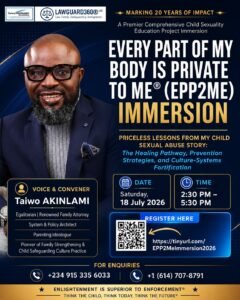
EVERY PART OF MY BODY IS PRIVATE TO ME® (EPP2ME) IMMERSION
Theme: Priceless Lessons from My Child Sexual Abuse Story: The Healing Pathway, Prevention Strategies, and Culture-Systems Fortification
Date: Saturday, 18 July 2026
Time: 2:30 PM – 5:30 PM
Voice & Convener:
Taiwo AKINLAMI
Egalitarian | Renowned Family Attorney | System & Policy Architect | Parenting Ideologue | Pioneer of Family Strengthening & Child Safeguarding Culture Practice
Registration is compulsory.
Register here:
https://tinyurl.com/EPP2MeImmersion2026