
18 Days Later: Nigeria’s Missing Children and the Cost of Insecurity
"There can be no keener revelation of a society's soul than the way in which it treats its children." — Nelson Mandela
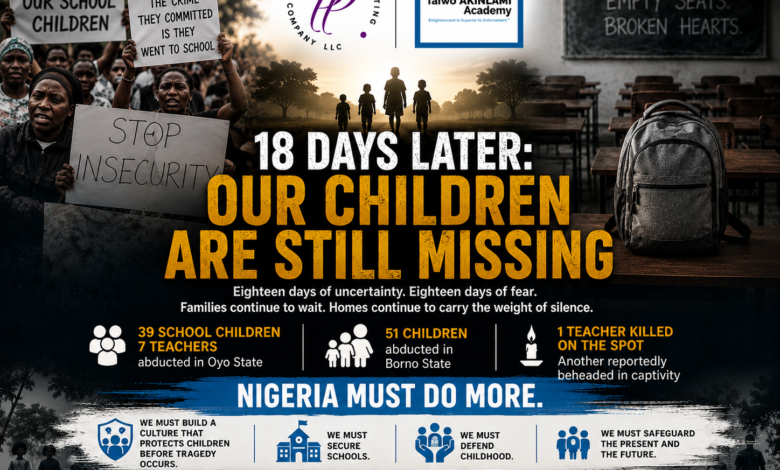
Eighteen days have passed since the tragic school abductions that occurred on May 15, 2026, in both Oyo and Borno States.
Eighteen days.
Eighteen days of uncertainty.
Eighteen days of fear.
Eighteen days of unanswered questions for families whose children left home for school but never returned.
As the nation continues its daily routines, many Nigerian children remain missing. Parents continue to wait. Families continue to grieve. Communities continue to carry the heavy burden of silence.
On May 15, heavily armed men attacked schools in Oriire Local Government Area of Oyo State, abducting 39 pupils and seven teachers. The attack also claimed the lives of two teachers. Reports indicate that one teacher was killed during the attack while another was reportedly murdered in captivity.
On the same day, suspected insurgents stormed Mussa Primary and Junior Secondary School in Askira-Uba Local Government Area of Borno State. More than forty children, including toddlers between the ages of two and five years, were abducted and reportedly used as human shields during the attackers’ escape.
Together, these incidents left nearly ninety children and educators unaccounted for.
Their only “crime” was going to school.
Across Oyo, Ogun and other parts of Nigeria, citizens have taken to the streets demanding action. Protesters have carried placards bearing painful but powerful messages:
“The crime they committed is they went to school.”
“Bring back our school children.”
“Our future is crying for help.”
These protests are not merely expressions of anger. They are cries from a nation that is growing weary of recurring tragedies and increasingly concerned about the safety of its children.
The concerns extend beyond the immediate abductions.
According to reports, families in Borno State have expressed frustration over what they perceive as unequal levels of attention and intervention. While a high-powered federal delegation visited affected communities in Oyo State, many families in Borno say they are still waiting for visible action and reassurance that their children’s lives matter equally.
Every child matters.
Every child deserves protection.
Every parent deserves answers.
Every Nigerian life deserves equal value.
Section 14(2)(b) of the Constitution of the Federal Republic of Nigeria states clearly that:
“The security and welfare of the people shall be the primary purpose of government.”
This responsibility belongs to every level of government:
Federal.
State.
Local.
The protection of children cannot be treated as a seasonal priority activated only after tragedy strikes.
Nigeria has seen this painful pattern before.
When the abduction of more than 276 schoolgirls from Chibok shocked the world in 2014, many hoped it would become a turning point in the nation’s commitment to protecting schools and children.
Yet more than a decade later, school abductions continue to occur.
Thousands of students have been kidnapped across Nigeria over the years. Classrooms that should represent safety, learning and hope have increasingly become targets of violence.
This reality should concern every Nigerian.
Schools are not battlefields.
Children are not bargaining chips.
Teachers are not expendable.
The conversation must move beyond reaction.
Beyond speeches.
Beyond sympathy.
Beyond promises.
Nigeria must build a culture of prevention rather than perpetual response.
We must secure schools before attacks occur.
We must strengthen intelligence gathering and community-based protection systems.
We must invest in safeguarding measures that place the safety and wellbeing of children at the centre of national security planning.
We must ensure that every school, regardless of location, is treated as a protected space.
Most importantly, we must remember that behind every statistic is a child with dreams, a family with hopes, and a future that deserves protection.
Today, many homes remain incomplete.
Many parents are still waiting for the sound of familiar footsteps.
Many siblings continue to ask questions no one can answer.
Many classrooms have empty seats.
The nation cannot become comfortable with this reality.
There is too much bloodshed in the land.
Too much grief.
Too much fear.
Government at all levels must focus on its primary purpose.
Protect the people.
Protect the schools.
Protect the children.
Because children are not merely the leaders of tomorrow.
They are our responsibility today.
And until every missing child is safely returned, the work remains unfinished.