Nigeria’s Children and the Crisis of Nationhood: How Nigeria’s Policy Gaps Are Shaping a Generation
Introduction
In 2026, the World Bank Group released its Women, Business and the Law report, and Nigeria scored zero out of 100 on supportive parenthood policies. Zero. In any assessment, that figure is alarming. In a country with one of the largest child populations in the world, it is devastating.
This score reflects the absence of mandatory paid leave for both parents, weak protections for pregnant employees, and virtually no enforceable childcare guarantees. At the same time, Nigeria carries the highest number of out-of-school children globally. Millions of those who are in school are not learning. Inflation is above 30 percent. Unemployment remains high. Over 63 percent of Nigerians live in multidimensional poverty.
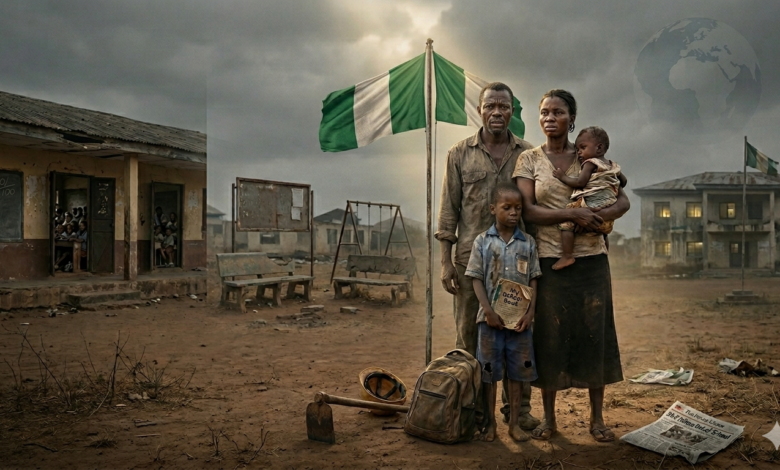
When these realities converge, the question is no longer about policy performance. It becomes a deeper question about national direction. What does it say about a nation when its children are structurally unsupported?
The Structural Failure of Parenthood Policies
The zero score on parenthood policies signals a systemic absence of legal safeguards. In many countries, paid parental leave is recognized as a foundation for healthy child development and workforce stability. In Nigeria, such guarantees are inconsistent and limited, especially in the private and informal sectors where most Nigerians work.
There is no robust national framework ensuring affordable, quality childcare. This gap disproportionately affects women, but it also affects fathers, employers, and ultimately the economy. When early childhood care is treated as a private burden rather than a shared societal responsibility, inequality deepens and child development suffers.
Gender equality laws exist on paper, but implementation is weak. Without funding, monitoring, and enforcement, legal rights remain theoretical.
Education in Crisis: Access Without Learning
According to the UNICEF and the UNESCO, 20.2 million Nigerian children are out of school, one of the highest figure in the world. That represents one in five of all out-of-school children globally.
Yet access is only part of the problem. The World Bank Group classifies Nigeria among countries experiencing “learning poverty,” meaning most 10-year-olds cannot read and understand a simple text. The British Council has noted that much of sub-Saharan Africa, including Nigeria, is two generations behind in foundational skills.
This learning deficit has long-term consequences. Children who cannot read by age ten are significantly more likely to drop out, struggle with employment, and remain trapped in cycles of poverty. An education system that does not produce literacy cannot produce economic transformation.
Economic Pressure and the Strain on Families
Nigeria’s economic realities intensify the crisis. With inflation above 30 percent and unemployment in double digits, survival has become the central preoccupation for millions of families. Multidimensional poverty affects over 63 percent of the population.
Economic stress reduces parental availability, patience, and stability. Parenting requires time and emotional presence. When families are preoccupied with daily survival, nurturing becomes secondary to sustenance.
The absence of social protection schemes, childcare support, and income stability compounds this strain. In such conditions, children are more vulnerable to exploitation, child labor, early marriage, and trafficking.
Insecurity and the Weaponization of Childhood
In 2024, more than 1,120 children were recruited by armed groups in Nigeria’s North-East, according to data released by UNICEF. These cases spanned Borno, Adamawa, and Yobe states.
Meanwhile, Gombe State Governor Inuwa Yahaya recently reported that, 48 children between the ages of two and five missing, allegedly trafficked outside the state and possibly beyond Nigeria’s borders.
These developments are not isolated security incidents. They reflect institutional weakness. When governance structures fail to protect children from recruitment, abduction, and exploitation, the nation’s moral and security foundations are compromised.
The Four Institutions and Nigeria’s Imbalance
Globally, four institutions shape a child’s development: the family, the community, the state, and the international system.
The family remains Nigeria’s strongest pillar. Despite economic hardship, Nigerian parents demonstrate extraordinary resilience and sacrifice. However, resilience without support has limits.
The community, including religious institutions and civil society, should reinforce positive values and provide social accountability. Yet social fragmentation and insecurity have weakened communal cohesion.
The state carries the ultimate responsibility to create enabling conditions through education, healthcare, security, and policy enforcement. Its inconsistent performance shifts disproportionate responsibility onto families.
The international community can provide support, but it operates through strategic interests. Sustainable reform must be domestically driven.
When the state falters and communities weaken, families absorb the shock. Over time, that shock becomes generational.
National Implications
Nigeria has one of the youngest populations in the world. Youth can be a demographic dividend, fueling innovation and growth. But without education, protection, and opportunity, youth can also become a demographic liability.
A country with 20.2 million out-of-school children cannot realistically expect rapid industrial or technological advancement. A nation scoring zero on parenthood protections cannot claim to prioritize family stability. A society where children are recruited into conflict faces long-term instability.
Conclusion
The statistics confronting Nigeria are sobering. Zero out of 100 on supportive parenthood policies. The highest number of out-of-school children in the world. Widespread learning poverty. High inflation and multidimensional poverty. Child recruitment into armed groups. Reports of trafficking and disappearance. These are not disconnected crises. They are interconnected symptoms of institutional fragility.
Nelson Mandela once observed that there can be no keener revelation of a society’s soul than the way it treats its children. By that measure, Nigeria stands at a defining moment. The country’s future will not be determined by speeches or revised curricula alone. It will be determined by whether concrete systems are built to protect families, strengthen education, stabilize the economy, and secure childhood.
Preparing children for the future is essential. Preparing the future for children is urgent. The difference between those two ideas may define the trajectory of the Nigerian nation for generations to come.