
The Ondo Students: The Real Test Is Not Their Conduct, but Ours
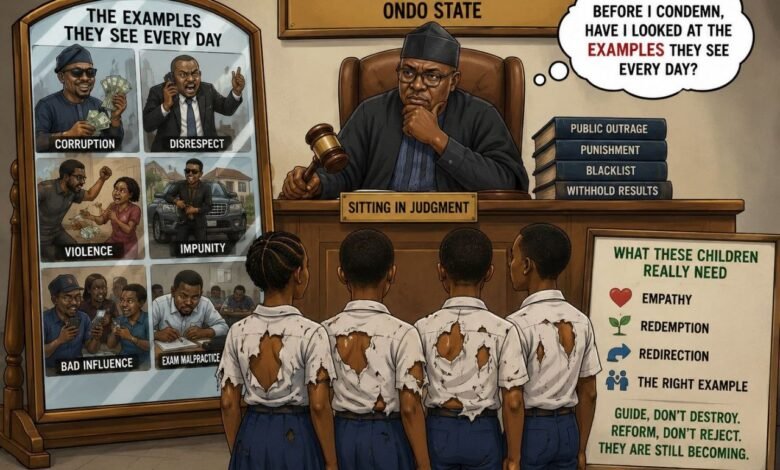
I have carefully followed the reports concerning the graduating students in Ondo State whose celebration after their final examinations has generated widespread public condemnation and attracted sanctions from the State Government.
Like many others, I have watched the reactions. Unlike many, however, I find myself asking a different set of questions.
The first is factual.
What exactly did these students do?
Public commentary has been heavy on conclusions but light on particulars. Were they merely tearing their uniforms in celebration? Did they assault anyone? Damage public property? Breach the peace? Commit any criminal offence? Or did they simply engage in conduct considered inappropriate and unbecoming of graduating students?
Facts matter because justice begins with facts.
The second question is legal.
Assuming, for the sake of argument, that the students violated school rules or even the law, what specific rule or law did they breach? More importantly, what disciplinary consequences are prescribed for that breach?
The rule of law requires more than the existence of misconduct. It requires that sanctions be founded on known rules, administered through due process, and proportionate to the conduct established.
Discipline must never become an expression of public outrage.
Yet there is an even deeper question.
What does the law require when children are the ones who have gone wrong?
Modern child justice systems do not begin with condemnation. They begin with the recognition that children are still developing. Consequently, even where children are found to be in conflict with the law, the governing principles are diversion, where appropriate, rehabilitation, reintegration, restoration, and redemption.
The objective is not simply to punish a child for yesterday’s mistake but to prepare that child for tomorrow’s responsibility.
That is why the true test of a child justice system is not how it responds to well-behaved children. It is how it responds when children misbehave.
Children do not lose their rights because they have exercised poor judgment.
Nor should adults abandon the principles of justice because children have disappointed them.
There is one final question we must ask ourselves.
If the conduct displayed by these students represents a behavioural failure, whose report card are we really reading?
Schools exist to produce learning outcomes and behavioural outcomes. Parents exist to nurture character. Society exists to model values. When children fail, the responsibility seldom belongs to the children alone.
The conduct of children often reflects the quality of the systems that formed them.
This incident should therefore invite more than punishment. It should provoke reflection.
Were the students wrong? Perhaps.
Should they be corrected? Certainly, if they breached established rules.
But should correction take the form of measures that are inconsistent with the philosophy of child justice, the rule of law, and the best interests of the child?
That is the question we should all be asking.
For the measure of a society is not merely how it celebrates its children when they succeed, but how it responds when they fail. More importantly, it is whether that society is willing to acknowledge that, in many instances, children fail only after the society has failed them first and must therefore first reckon with itself.
We must therefore look around us and ask a more uncomfortable question:
What investment has our society made in the values and behaviours it desires to see in its children?
That investment begins, first, with the examples we set and, second, with the values we intentionally teach through our homes, schools, faith communities, and every other public and private institution.
Discipline is first a culture before it becomes an instruction.
Long before children understand our instructions, they effortlessly observe, absorb, and imitate our examples—both good and bad.
That is why I often say that our precious children are either the beneficiaries or the casualties of our examples.
A society that does not understand this is either hypocritical or unaware that it cannot reap what it has not sown. Life has always operated on the principle that we reap what we sow. When we do not like what we see in the mirror, wisdom demands that we change ourselves—not blame the mirror.
This brings me to one final question.
If schools exist to produce both learning outcomes and behavioural outcomes, what proportion of our educational investment is devoted to each?
It is widely observed that our education system overwhelmingly prioritises hard skills while giving comparatively little attention to the deliberate development of soft skills such as character, self-discipline, emotional intelligence, empathy, communication, responsibility, leadership, and conflict resolution.
Yet it is these very qualities that determine how people conduct themselves in moments such as these.
If we invest predominantly in academic achievement while underinvesting in character formation, should we be surprised when we harvest academic success without corresponding behavioural maturity?
Perhaps the greatest lesson from the Ondo incident is not about the students at all.
Perhaps it is about us.
One final suggestion. I would consider replacing the title with: