The Ooni and Baba Ijesha’s Association: Beyond the Denial of Chieftaincy Title Conferment
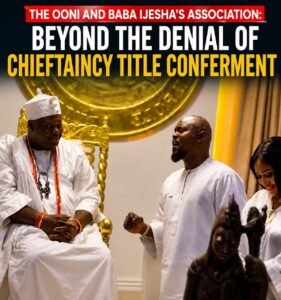
The issue is no longer whether Baba Ijesha was conferred with a chieftaincy title.
The Ooni’s Palace has denied that.
For me, that is no longer the point.
The point is the public association.
I have watched the video of Baba Ijesha’s visit to the palace. It was elaborate. It began with him dancing into the palace with his wife. He was received with royal protocol. The visit was professionally recorded and later made public.
That could not reasonably have happened without the knowledge and consent of the Palace. If a visit is officially recorded, it is ordinarily because it is intended to be seen.
That is where my concern lies.
Child safeguarding is not only about what we formally confer. It is also about the messages we communicate through our associations.
Around the world, public figures have paid a significant reputational price simply because they associated with Jeffrey Epstein. Many were never accused or convicted of participating in his crimes. Yet their association with him came under intense public scrutiny because people understood that association communicates something.
Association matters.
Baba Ijesha is not merely someone against whom allegations were made. He was convicted by the High Court, and that conviction was affirmed by the Court of Appeal.
Unless and until a competent court sets those judgments aside, they remain the legal position.
Against that background, we must ask ourselves:
What culture are we promoting when respected institutions publicly associate with a convicted child sex offender in a manner capable of enhancing his public image?
This is not about denying anyone dignity as a human being.
Neither is it about saying that a convicted person can never rebuild his life.
It is about recognizing that public rehabilitation is different from private compassion.
Private compassion restores people.
Public celebration—or conduct capable of being perceived as public endorsement—can unintentionally undermine the culture of accountability that child safeguarding requires.
Our children are always watching.
So are survivors of child sexual abuse.
The question every public institution should ask is not merely:
“Do we have the right to receive this person?”
It is also:
“What message does this association send to the children we are duty-bound to safeguard and protect?”
What I am afraid of is the culture we are gradually building.
It is a culture that can normalize, celebrate, or inadvertently glorify those convicted of child sexual offences.
That culture is dangerous.
It endangers our precious children.
That is my concern.
That is why it must be called out.
Enlightenment is Superior to Enforcement®