Across Europe, the First Day of School Is Not One Day
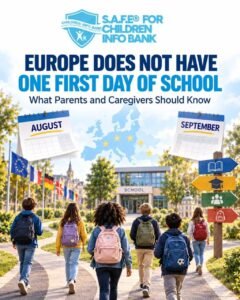
From early August in Finland to the end of September in Malta, Europe’s staggered school calendar carries an important message for parents and caregivers: children do not all have to begin the academic year at the same time to receive a meaningful education.
For some European children, the new school year began while much of the continent was still deep in summer.
In Finland, schools reopened between August 6 and 13. Denmark followed between August 10 and 13. Children in parts of Sweden returned between August 17 and 19.
Elsewhere, families were still on holiday.
Students in several European countries did not return until September. Some Italian schools are not scheduled to reopen until as late as September 21. Portugal’s resumption period extends to the same date, while children in Malta may wait until September 30.
The wide variation was highlighted in a school-resumption calendar published by the European Commission, which observed that there is no single first day of school across Europe. Some children return in August; others remain on holiday until late September. (European Commission )
The calendar offers more than an interesting comparison of dates.
For parents and caregivers, it challenges the assumption that there is one universally correct time for children to return to school, or that an earlier resumption date necessarily reflects a more serious or effective education system.
One continent, many school calendars
The differences are striking.
Finland and Denmark began reopening schools in early August. Sweden and the Netherlands followed later in the month. Belgium’s dates extended from August 24 to September 1, while Ireland’s reopening period ran from late August into early September.
September 1 served as the principal reopening date in Czechia, Estonia, France, Hungary, Latvia, Lithuania, Poland, Slovakia and Slovenia.
Croatia and Romania resumed on September 7. Austria and Cyprus had reopening dates of September 7 or 14. Spain’s calendar extended from September 7 to 15, while Italy’s stretched from September 7 to 21.
Greece was scheduled for September 11. Portugal’s reopening period ran from September 11 to 21. Bulgaria followed on September 15, Luxembourg between September 15 and 17, and Malta on September 30.
Germany presented the broadest range, with schools resuming at different times between August 7 and September 14.
These ranges are important. They show that even within individual countries, the first day of school may vary by region, school level or local education authority.
A national label does not always produce a single national school calendar.
Parents should therefore treat comparative graphics as general guides, not as substitutes for information from their children’s schools or local education authorities.
The calendar is not the education
The European timetable raises a larger question: What actually determines the quality of a child’s education?
It cannot be the resumption date alone.
A country that resumes school in early August is not automatically providing better education than one that resumes in mid-September. In the same way, a longer school year does not, by itself, establish that children are learning more effectively.
The real questions concern what happens when children enter the classroom.
Are they physically and emotionally safe?
Are teachers prepared and properly supported?
Does the curriculum develop understanding, competence, character and independent thought?
Are children with disabilities and additional learning needs included?
Can a child report mistreatment without fear?
Do parents and schools communicate effectively?
Does the system recognise that children return from holidays with different experiences, needs and levels of readiness?
The date on which school begins matters, but the culture and quality of the school matter more.
Preparation should not become panic
Back-to-school periods can place considerable pressure on families.
Parents may have to pay fees, purchase uniforms and books, arrange transportation, reorganise work schedules and restore household routines, all within a short period.
Children also face their own transition. Some are eager to return. Others may be anxious about a new school, unfamiliar teachers, academic expectations, friendship difficulties or a previous negative experience.
The staggered European calendar offers a useful reminder: preparation does not have to be governed by panic.
A responsible transition begins with accurate information.
Parents and caregivers should confirm the actual reopening date directly with the school. They should review transportation arrangements, emergency contacts, authorised pickup information, health needs and any changes in the child’s circumstances that the school should know.
Children should also be included in the preparation.
A conversation about what they expect, what excites them and what worries them may reveal more than a perfectly packed schoolbag.
For younger children, restoring bedtime and morning routines gradually may make the transition less disruptive. For older children, preparation should include honest discussion about academic pressure, friendships, online behaviour and how to seek help when something feels wrong.
Every family has its own first day
The most important lesson from Europe’s varied calendar may be that education systems—and families—do not all operate according to one clock.
Some children resumed school in the first week of August. Others will not enter the classroom until the final day of September.
Yet every one of those children deserves the same essentials: safety, dignity, competent teaching, meaningful learning and a strong partnership between the adults responsible for their development.
Parents should resist measuring preparedness merely by how early a school reopens, how expensive its requirements are or how much work it assigns from the first day.
The better measure is whether the school is ready for the child, and whether the family and the school are prepared to work together in the child’s best interests.
Across Europe, the school year begins on many different dates.
For every child, however, the first day should communicate the same message:
You are expected.
You are protected.
You belong here.
And your education is about much more than returning to a classroom.